Volume 18 of the OJBR presents E-portfolios as Learning Tools for Applied Double Bass Study; a Research-Based, Practice Oriented Approach by Mark Elliot Bergman.
Abstract: Applied double bass teachers (or double bass studio teachers), including at the post-secondary level, typically engage one-on-one with students over the course of several years. Unlike their counterparts in post-secondary education who typically work with a student cohort over a more limited stretch of time (like a semester or trimester), applied double bass teachers have the pleasure of, and responsibility for, guiding learners through a multi-year process of growth and development. Employed in higher education since the 1990s, E-portfolios are a powerful pedagogical tool improving instructional efficacy and documenting iterative learning. The author offers several research-based, practice-oriented assignments for double bass instructors to use when employing learning e-portfolios with students. The suggested assignments help students develop a basic musical vocabulary through studying scales and bow articulations and curating video artifacts as part of an e-portfolio.
Mark Bergman's award-winning article examines the use of E-portfolios in double bass applied teaching on the college level. More importantly, the article offers practical lesson plans. Any bassist who is involved in studio teaching would be interested in this article, as would any studio teacher on any instrument.
The article was the winner of the 2022 ISB Research Competition, in the Professional Division.
Dr. Mark Elliot Bergman is the Director of Strings and Orchestral Studies at Sheridan College and the double bass studio instructor at the University of Wyoming. He is also the Assistant Principal Double Bassist of the Billings Symphony Orchestra. During the summer, Mark performs with Assisi Performing Arts in Assisi, Italy and the Peter Britt Festival Orchestra in Jacksonville, Oregon. He is the former Principal Double Bassist of the New Haven Symphony Orchestra and the Mato Grosso Chamber Orchestra in Cuiabá, Brazil. He formerly served as a Professor of Music History and Ensemble Director at George Mason University in Fairfax, Virginia. With Wyoming Baroque, Mark released three CDs, two featuring his original compositions for historically informed performers. He received the 2018 Performing Arts Fellowship from the Wyoming Arts Council to recognize his work as a composer and performer. Mark has published two books about popular music pedagogy. He earned his doctorate from George Mason University in 2015, and he also holds degrees from Yale University, the Eastman School of Music, and the Manhattan School of Music.
Applied double bass teachers (or double bass studio teachers), including at the post-secondary level, engage one-on-one with students for several years. Unlike most post-secondary educators who typically work with a student cohort over a more limited stretch of time (like a semester or trimester), applied double bass teachers have the pleasure of, and responsibility for, guiding learners through a multi-year process of growth and development. Employing e-portfolios as part of double bass studio training can be a crucial part of helping students develop important, fundamental musical skills and documenting that learning over an extended period.
Increasingly, educators in diverse disciplines employ electronic portfolio (a.k.a. e-portfolio) assessment (Berkeley Center for Teaching and Learning, 2022; Hickey and Webster, 2001; Kim and Yazdian, 2014; Jensen and Trever, 2014). E-portfolio learning is especially ubiquitous in higher education. As Roberts, Maor, and Herrington (2016) noted, "ePortfolios are being used increasingly as an assessment tool, particularly in terms of demonstrating skills, abilities, and achievements against set criteria or required competencies" (p. 22). Kim and Yazdian (2014) concur, noting, "portfolio assessment provides enriching contexts for crafting quality teaching for all students. Student work samples included in learning portfolios demonstrate the growth and progress that each student has made" (p. 225).
Defining essential skills and establishing parameters for learners collecting work samples helps make the most of an e-portfolio's potential efficacy. Amongst string pedagogues, there is a broad consensus that studying scales is essential for double bassists to build a strong technical and conceptual foundation (ABRSM, 2020; Amoroso, 2022; Schiller, 2004; Zlata, 2013). Asking learners to employ and record scale studies (in consort with a basic vocabulary of bow strokes) also provides valuable artifacts for students to curate and reflect upon as part of an e-portfolio. Such study forms the basic vocabulary of good musicianship for double bassists, which can be applied in many performing contexts. Deliberate, reflective practice properly documented and curated in an e-portfolio enhances iterative learning among student double bass players over the multi-year process of post-secondary education.
Introduced into the higher education landscape in the early 1990s, e-portfolios "have become standard artifacts which students collate, archive, reflect on, and present outcomes of their studies" (Dunbar-Hall et. al, 2015, p. 140). Their use, now ubiquitous across the higher education landscape, is employed by educators and learners from a vast array of disciplines. Most colleges and universities now utilize e-portfolios as a learning tool (Jensen and Trever, 2014). While content varies, curation and reflection are at the heart of the e-portfolio's functionality as a learning tool. Learners collect artifacts and reflect upon them. As Rickard (2008) observed, "the reflection provides evidence of learning alongside the trajectory of developing performances" (p. 35). This approach has special resonance for learners in applied music. Computer-based portfolio (e-portfolio) technology provides advantages for musicians collecting and curating audio recordings and filmed events. It also provides advantages for reflecting on these artifacts for the purposes of iterative improvement. Furthermore, an e-portfolio allows the curator to merge multiple aspects of their professional identity in one place (performer, teacher, composer, sound engineer, luthier, publisher, scholar, etc.).
Writing in general terms, Hill (2008) described a portfolio as "an organized collection of artifacts (examples of work), documenting a person's skill and growth" (p. 61). Electronic portfolios include digital artifacts curated as part of a blog or website and can be particularly helpful to musicians working in a multimedia environment. They also provide some significant advantages over paper portfolios, especially in the arts. Roberts, Maor, and Herrington (2016) noted the value of e-portfolios "in artistic fields as a means of showcasing skills and abilities through work samples and documentation of performances" (p. 22). Other advantages include employing hypertext links, easily modified content, easy distribution, and the opportunity to showcase technology skills (Hill, 2008, p. 66).
In an educational context, curation should include the "purposeful collection of sample student work, demonstrations, and artifacts that showcase student's learning progression, achievement, and evidence of what students can do" (Berkeley Center for Teaching and Learning, 2022, para. 1). Educators (including music educators) were among the first to recognize the pedagogical and andragogical potential of e-portfolios in the arts. As Dunbar-Hall et al. (2015) noted, e-portfolio usage "has been tracked as more frequent in specific discipline areas. Research indicates their prevalence in degree programs for professional accreditation, such as health education and teacher education" (p. 144). The Penn State Music Education program, for example, "requires the design and development of electronic portfolios as part of the educational development of its students. The portfolio process is a framework for helping students see the connections between their music, education, and music education coursework (The Penn State School of Music, 2022, para. 1).
Curation and reflection are also important for applied instrumental studies. For learners studying an instrument, composition, or conducting, an e-portfolio will include artifacts of and reflections upon the learner's developing craft. The University of Utah (2014) describes artifacts to learners as
"a critical aspect of your learning portfolio. An artifact is anything that can provide evidence of your education and experiences. This will likely be primarily coursework, including essays, projects, presentations, or anything else assigned to you in class. For co-curricular experiences, you will likely include more media-driven artifacts, such as video and photographs. Reflection may also be used as an artifact" (para. 3).
The National Association for Music Education (2022) articulated the educational value of curating artifacts for music students in stating, "for the sake not only of assessment but also instructional quality, schools should . . . provide recording devices and other technology to facilitate the collection, management, and scoring of students' music work" (para. 3). Learners curating artifacts can upload recordings and videos to online repositories (like YouTube or Vimeo) and collect hyperlinks as part of a digital database or e-portfolio. Many free sites allow for building an e-portfolio with little or no technical training, including WordPress, Weebly, and Google Sites. The portfolio provides a repository for learners to see and hear their growth through their course of study. "Because student work samples are collected over time," noted Kim and Yazdian (2014), "student portfolios demonstrate growth and progress that individual students make" (p. 222).
As a double bass educator, I endeavor to keep abreast of current educational developments and trends including the appropriation of e-portfolios as a learning tool. Emphasizing the language of basic musicianship to my students is also a priority for me. To that end, I begin each semester working on the detaché bow stroke. This bow stroke is described by Elliot (2017) as "the basic bow stroke when you play with separate bows" (00:14 – 00:18). Rabin and Smith (1991) emphasize the requisite tone in describing this stroke as incorporating "alternating bow direction with a smooth, connected stroke and evenness of tone" (p. 7). My students practice the detaché stroke using three segments of the bow; the lower third near the frog, the middle third, and the upper third near the tip. I emphasize developing an even, warm sound with smooth bow changes. To complete the unit, the student records two-octave scales (C major, A melodic minor, G major, E melodic minor) at quarter note = 60 and posts the video to their electronic portfolio where we can review it together.
The recorded video (due within the first few weeks of the semester) becomes the first artifact curated into the learner's e-portfolio and confers strategic and pedagogic advantages. Firstly, specific moments in the video can be referenced and reviewed in slow motion. If the learner experiences challenges maintaining an even tone or other issues emerge, individual moments can be isolated and reviewed with the student. In my experience, referencing a specific comment tied to a specific timing in the video focuses the learner's attention in powerful ways. When the learner is not focused on playing, they can focus their total attention on observation. Having the teacher serve as a guide is crucial. Laurel (2016) summed up the importance of this process by noting "Many students don't even notice such sound variations in their strokes and bow changes until someone points them out or they record themselves-they're too focused on the next notes of the passage to finish listening to what they're playing" (p. 23).
Secondly, the artifact becomes the focus of studied reflection. I ask my students to provide brief written commentary after reviewing the artifact by answering the following questions;
If this is your first time completing this assignment, answer the following questions. Feel free to use creative language. How does your arm move? What did you do to improve your tone quality as you worked on your recording? What did you learn during your practice? Were the videos helpful? Why or why not?
If this is not the first time you have worked on this assignment, answer the following questions: What improvements have you made in mastering the détaché. Describe any changes in your conception of this stroke. Reflect on the fine motor skills required to make a smooth transition between the upbow and the downbow. How do the fingers, wrist, and forearm work to ensure a smooth, even stroke?
The learner must retain the artifact so they can document progress over time, fulfilling an e-portfolio's potential to "demonstrate knowledge, skills, and growth" (Roanoke College, 2022, para. 1).
The second artifact I collect from students is a video of scale playing against a drone. Drones can be a crucial tool for helping double bassists develop reliable intonation. Pirastro Strings Artist and double bass clinician Lauren Pierce (2016) commented upon this in her Discover Double Bass interview, noting "I practice with drones all the time . . . a drone is so great for your intonation" (Chalmers, 1:04 – 1:20). For this assignment, I ask my double bass students to record themselves playing major and melodic minor scales against an audible drone in quarter notes at quarter = 60 in a detaché style. My students may set the drone on the root of the scale or the fifth scale degree of the scale. In my experience, these drones reveal different intonation challenges. For example, playing against the fifth scale degree tends to make intonation issues with scale degree two and scale degree seven much more evident than when playing against the tonic.
When reflecting on this artifact, I ask my students to listen to which pitches are out of tune and identify if they are flat or sharp. Also, I ask them to review the video for themselves, playing in slow motion. Is the shifting motion smooth? Is the double bass stable when the player is shifting? In my experience, many young double bass players use their left hand to help stabilize the instrument. When shifting, the instrument becomes unstable. The instability is often visible when playing the video back in slow motion. Visualizing shifting problems helps students make appropriate adjustments in their physical approach to the instrument, which may improve intonation significantly. Being able to reference specific moments in the video also helps foster student learning and focus practice goals.
The third artifact I collect helps students develop a basic vocabulary of bow articulations. Using the bow effectively is fundamental for double bass players learning to be musically expressive and contribute to an ensemble. Ed Barker, Principal Bassist of the Boston Symphony, said, "it has to be understood that the approach to articulations has to do with the way we approach music and phrasing in general. The articulations aren't necessarily an end in themselves, but they are a means to creating and producing very, very sophisticated musical phrasing" (Heath, 2006, 22:18 – 22:43). Rabin and Smith (1991) concur in observing "Bowing styles and bowing strategies are keys to a musical and stylistic performance" (p. 1). Building bow articulation skills as a core element of musical phrasing and expression for developing double bassists is essential. As Hickey and Webster (2001) observed, "In refining a philosophy of music education with creative thinking in music as a core element, teachers should combine skill building with creative thinking" (p. 22).
I encourage my students to develop seven basic bow strokes, starting with four on-the-string strokes. This approach is highly influenced by Ed Barker, who noted that on-the-string strokes include "articulations like legato, marcato, portato, some aspects of the detaché and a lot of the accented gestures" (Heath, 2009, 24:50 – 25:26). The off-the-string articulations include the "carried detaché," martelé, and spiccato. According to Barker, the carried detaché "is essentially an off-the-string bow stroke . . . where the movement for the bow stroke starts in the air, not from the string. This carried detaché is essentially like an airplane landing and taking off" (Heath, 2009, 31:50 – 32:26).
While building these skills with students, it is important to clarify instructions for employing these strokes and emphasize the goal of enhancing creativity and expressive playing. Developing fundamental skills is in the service of more expressive playing and a more robust contribution to performing with ensembles. As Kim and Yazdian (2014) noted, "to create student learning portfolios, teachers need to identify instructional goals and communicate these to students" (p. 222).
The fourth artifact my students prepare is a run-through of their jury materials. Preparing for a performance, especially for developing students, presents challenges. As Kaplan (2004) noted, "it is both mysterious and tragic that after practicing several hundred hours for a performance, a musician can be disappointed with the result" (p. 43).
My institution (Sheridan College) requires string majors to demonstrate competency in scales and bow articulations as well as a prepared piece. As part of a learning e-portfolio, I ask my students to record themselves playing their entire jury. There are several reasons for this. Firstly, I find that students often have unrealistic expectations of their preparedness. Expectations can be unrealistic because, in a performance situation, the student "must produce a satisfying performance on the first try, at a prearranged moment, on a prearranged day (Kaplan, 2004, p. 43). Documenting a performance artifact (i.e., a recording) in advance of the jury helps manage expectations for the actual performance.
Secondly, the recording becomes an important artifact used as part of the learning portfolio. Students can reflect on their performance experience and make notes for improvement. Also, curating mock jury videos allows the student to document iterative progress from semester to semester and from year to year.
Thirdly, the mock jury video recording allows the instructor to offer specific feedback corresponding with a time mark in the video. In my experience, pointing out specific moments in the student's jury material along with suggestions for improvement helps focus practice, especially in the days and weeks leading up to a jury. For example, telling a student the F# in bar 43 is flat and helping diagnose the technical reasons for the error is much more effective and actionable than informing a student that intonation should be improved in a general way. Specifying instructional goals for learners building e-portfolios is an important driver for learning. (Kim and Yazdian, 2014). In applied double bass studies, there are profound advantages to communicating learning goals that are specific and actionable in the weeks leading up to a major performance like a jury.
E-portfolios offer many opportunities for learners to collect, curate, and reflect upon self-created artifacts. In addition to the materials referenced above, e-portfolios can also contribute to the growth of double bass students by asking them to collect and reflect on the following:
Individual instructors may choose to emphasize certain aspects of training. Furthermore, incorporating e-portfolios as a learning tool does not require a teacher to embrace all aspects of e-portolio learning. Just like instrumental education, embracing e-portfolios can be an iterative and incremental process. As Chenette (2016) noted, "one of the most difficult aspects of changing one's teaching is prioritizing change: even teachers who enthusiastically agree with the aims and methods of a curricular change can feel overwhelmed when it comes to actually figuring out how much to do in a given class and term. Unless one has unlimited time, change must, of necessity, be incremental" (p.6). Instructors can collect student artifacts based on educational goals, and these goals may evolve. After all, "Reflecting on practice is an essential skill for teachers" too (The Penn State School of Music, 2022, para. 2).
More broadly, curated e-portfolios allow learners to engage in critical thinking and autodidactic learning that transfers across disciplines. In this context, the specific nature of the discipline (excellence in double bass playing) is less relevant than the broader pedagogic and andragogic goals of learning how to learn. Self-reflection, critical thinking, and problem-solving are central to the specific nature of this study but have broader implications and applications. Just as scale studies and bow stroke analysis are steppingstones to more fulfilling music-making, self-reflective musical study is a steppingstone to more fulfilling living.
It is sometimes said that teachers are in the business of making themselves redundant. In other words, the best teachers provide their students with the tools to teach themselves. The most successful manifestations of e-portfolio learning leverage technology to help learners become their own teachers. In this way, teachers can extend the teaching and learning process beyond the few precious years we have with our students.
ABRSM. (2022). ABRSM: Double Bass Grade 8. Practical Double Bass Grade 8. View Website
Amoroso, R. (n.d.) The Truth About Violin Scales. Retrieved August 4, 2022, from View Website
Asmus, E. P. (1999). Music Assessment Concepts. Music Educators Journal, 86(2), 19–24. View Website
Berkeley Center for Teaching and Learning. (2022). E-Portfolio | Center for Teaching & Learning. E-Portfolio. View Website
Blom, D., Rowley, J., Bennett, D., Hitchcock, M., & Dunbar-Hall, P. (2013). Two-way Impact: Institutional e-Learning Policy/Educator Practices in Creative Arts Through ePortfolio Creation. European Conference on E-Learning, 33–XII. View Website
Brewer, S. (2020, November 6). What Does A Music Portfolio Consist Of? [Solved] - The Uncaged Musician. View Website
Buffington, M. L. (2011). Preparing a Professional Teaching Portfolio for an Art Teaching Position. Art Education, 64(3), 11–17.
Burrows, J., & Kumar, V. (2018). The Objective Ear: Assessing the progress of a music task. Smart Learning Environments, 5(1), 1–9. View Website
Chalmers, G. (Director). (2016). Discover Double Bass: Double Bass Practice with Drone Notes. View Website
Chenette, T. K. (2016). Creativity in the College Music Classroom: Guidelines for Effective Integration. College Music Symposium, 56. View Website
CIM. (2022). Cleveland Institute of Music Jury Examination Requirements. View Website
Collin, R. (2012). Composing the Career Portfolio and the Classed Subject. Research in the Teaching of English, 46(3), 260–284.
Dell, C. (2010). Strings Got Rhythm: A Guide to Developing Rhythmic Skills in Beginners. Music Educators Journal, 96(3), 31–34.
Drone Tone Tool. (n.d.). Drone Tone Tool. Retrieved August 6, 2022, from View Website
Dunbar-Hall, P., Rowley, J., Brooks, W., Cotton, H., & Lill, A. (2015). E-Portfolios in Music and Other Performing Arts Education: History through a Critique of Literature. Journal of Historical Research in Music Education, 36(2), 139–154.
Elliot, C. (Director). (2017). European String Teachers Association UK; Double bass technique: Detaché. View Video
Elmholdt, C., & Brinkmann, S. (2005). Discursive Practices at Work: Constituting the Reflective Learner. In Productive Reflection at Work. Routledge.
Floyd, S. A., & Kageff, B. K. (1978). Productivity Models for Applied Music Professors. College Music Symposium, 18(1), 105–108.
Grillo, J. (2009, June 6). CBC 120: Ed Barker interview. Contrabass Conversations. View Website
Ha, J. (2015). Teaching intonation in violin playing: A study of expert string teaching. Australian Journal of Music Education, 2, 224–236.
Heath, J. (2006). 165: Ed Barker Interview (from the archives). Contrabass Conversations. View Website
Hickey, M., & Webster, P. (2001). Creative Thinking in Music. Music Educators Journal, 88(1), 19–23. View Website
Hill, C. F. (2008). A Portfolio Model for Music Educators. Music Educators Journal, 95(1), 61–72.
Jenson, J. D., & Treuer, P. (2014). Defining the e-portfolio: What It Is and Why It Matters. Change, 46(2), 50–57.
Kaplan, B. (2004). Practicing for artistic success: The musician's guide to self-empowerment. Perception Development Techniques.
Kim, Y., & Sensale Yazdian, L. (2014). Portfolio Assessment and Quality Teaching. Theory Into Practice, 53(3), 220–227.
Lubert, V. J., Gröpel, P. (2022). Testing interventions for music performance under pressure: A randomized controlled study. Sport, Exercise, and Performance Psychology, 11(1), 93–105. View Website
Madora, R. (n.d.). Organizational Skills for Bassists: A Checklist for Getting There. No Treble. Retrieved August 1, 2022, from View Website
Manfredo, J. (2006). Effective Time Management in Ensemble Rehearsals. Music Educators Journal, 93(2), 42–46. View Website
Manning, D., Feurzeig, D., George, D., Glennon, M., Hoffman, P., & Tetel, M. (2019). Recruitment and Retention in the Applied Music Studio: A Critical Examination of Curricular and Institutional Demands. College Music Symposium, 59(1), 1–26.
Mick, J. (2015) Double Bass 101: Foundations for Building Strong Players: Florida Music Educators Association Download PDF
Morton, M. (1991). Dr. Morton's Miraculous Scale Fingerings for the Double Bass. Basso Profondo Publications.
National Association for Music Education. (2022). Assessment in Music Education. NAfME. View Website
Niles, L. (2020). How To Master the Legato Bow Stroke (Hint: It's Harder Than You Think). Strings Magazine. View Website
Norwalk Community College. (2022). EPortfolio [What is an e-portfolio]. Norwalk Community College. View Website
Rabin, M., & Smith, P. (1991). Guide to orchestral bowings through musical styles. 62.
Rickards, W. H., Diez, M. E., Ehley, L., Guilbault, L. F., Loacker, G., Hart, J. R., & Smith, P. C. (2008). Learning, Reflection, and Electronic Portfolios: Stepping Toward an Assessment Practice. The Journal of General Education, 57(1), 31–50.
Roanoke College. (2022). E-Portfolios for Psychology Majors. What Is an E-Portfolio? View Website
Roberts, J. S. (2012). Infusing Entrepreneurship Within Non-Business Disciplines: Preparing Artists and Others for Self-Employment and Entrepreneurship. Artivate, 1(2), 53–63. https://doi.org/10.1353/artv.2012.0005
Roberts, P., Maor, D., & Herrington, J. (2016). ePortfolio-Based Learning Environments: Recommendations for Effective Scaffolding of Reflective Thinking in Higher Education. Journal of Educational Technology & Society, 19(4), 22–33.
Schiff, H. (2004). Scales and exercises are essential for all string players. The Strad. View Website
Schon, D. A. (1991). Educating the Reflective Practitioner: Toward a New Design for Teaching and Learning in the Professions (1st edition). Jossey-Bass.
Sheeba. (2017, January 20). Music Through Light: Double Bass Instrumentalist Lauren Pierce. Sheeba Magazine. View Website
Silveira, J. M. (2013). Idea Bank: Portfolios and Assessment in Music Classes. Music Educators Journal, 99(3), 15–24.
String Technique (Director). (2017, October 3). Double Bass Detaché Bow Stroke Characteristics. View Video
Taylor, J., Dunbar-Hall, P., & Rowley, J. L. (2012). The e-portfolio continuum: Discovering variables for e-portfolio adoption within music education. Australasian Journal of Educational Technology, 28(8). View Website
Team, S. (n.d.). Double Bass Practice Do's And Don'ts. Retrieved August 1, 2022, from View Website
Thomsen, L. (2016, January). 6 Ways to Improve Your Détaché Bow Stroke. Strings, 30(6), 22–23.
Townsend, K. (2003). String-playing skills to enhance student and audience perception. Music Educators Journal, 89(3), 69–70.
The Penn State School of Music Undergraduate e-Portfolios. (2022) Retrieved August 3, 2022, from View Website
University of Utah (2015). Learning Portfolios; Teaching and Learning Technologies. View Website
University of Wyoming (2022). Undergraduate Sophomore Barrier Exam (Double Bass). Retrieved August 8, 2022 from Download PDF
van der Schaaf, M., Donkers, J., Slof, B., Moonen-van Loon, J., van Tartwijk, J., Driessen, E., Badii, A., Serban, O., & Cate, O. T. (2017). Improving workplace-based assessment and feedback by an E-portfolio enhanced with learning analytics. Educational Technology Research and Development, 65(2), 359–380.
Willard, C. (2019). Reconsidering the Value. Journal for Learning through the Arts, 15(1). View Website
Witzel, B. (2015). Scales for the Double Bass. CreateSpace Independent Publishing Platform.
Zlata. (2013, October 16). What is a Scale and Why Should You Study Them? Violin Lounge. View Website
The détaché (detached) bow stroke is the basic bow stroke in string playing. The détaché stroke uses an even amount of weight and speed throughout the stroke to create an unaccented beginning. However, each stroke is distinct. For this assignment, you will record yourself employing the détaché bow stroke and posting these recordings to your e-portfolio as an artifact.
Ed Barker, Principal Bassist of the Boston Symphony, describes the détaché stroke in the following way: "this (stroke) is where we draw the bow. We stop the bow. Then we start the bow again in the other direction . . . . it makes for a clean break in the bow changes but not having a consonant attack on the bow change" (Heath, 2006, 28:00).
It is important to develop a reliable détaché stroke in different parts of the bow. Record yourself playing the following two-octave scales in quarter notes at quarter note = 60 using the détaché stroke; C major, A melodic minor, G major, and E melodic minor. Record each scale three times using three different segments of the bow (lower third, middle third, and upper third). You may find the resources listed under "references" helpful in preparing this assignment.
Reflect on your learning process by answering the following questions and posting your reflections to your electronic portfolio. Your reflection should be a minimum of 250 words.
If this is your first time completing this assignment, answer the following. Feel free to use creative language. How does your arm move? What did you do to improve your tone quality as you worked on your recording? What did you learn during your practice?
If this is not the first time you have worked on this assignment, answer the following questions: what improvements have you made in mastering the détaché stroke? Describe any changes in your conception of this stroke. How has your execution improved? Reflect on the fine motor skills required to make a smooth transition between the upbow and the downbow. How do the fingers, wrist, and forearm work to ensure a smooth, even stroke?
Elliot, C. (Director). (2017). European String Teachers Association UK; Double bass technique: Detaché. View Video
Heath, J. (2006). 165: Ed Barker Interview (from the archives). Contrabass Conversations. View Website
String Technique (Director). (2017, October 3). Double Bass Detaché Bow Stroke Characteristics. View Video
Scales are the foundation of music and reliable intonation. For this assignment, you will work with two-octave major and minor scales. Please be consistent with your fingering choices. I recommend employing a scale book (see recommendations under "references"). You will record yourself playing two-octave scales against a drone and post the recordings to your e-portfolio as an artifact.
It is very helpful to practice scales with a drone. In my experience, the app Drone Tone Tool is an excellent resource (available via Google Play or the App Store) for mobile devices. If you do not wish to buy the app, you can access the audio using a browser here. Working with a tuner is very helpful. Sound Corset does a nice job picking up the low frequencies of the double bass. It is available for free in the Apple and Google Play stores.
Different intonation issues will become more apparent depending on the scale degree that you use as a drone. For example, practice against a drone on the root of the scale AND against the fifth of the scale. When you play against the fifth of the scale, it will be easier to tune seconds and sevenths.
Record yourself playing the following two-octave scales (up and down) against an audible drone (either the root or the fifth) and post your scales to your electronic portfolio. Begin by playing quarter notes at quarter note = 60 in a detaché style. Listen carefully for intonation on every interval! You must practice the shift slowly and smoothly so that you hear and feel the distance between each note.
Scales: D major, B melodic minor, A major, F# melodic minor
Answer the following questions:
Drone Tone Tool. (n.d.). Drone Tone Tool. Retrieved August 6, 2022, from View Website
Morton, M. (1991). Dr. Morton's Miraculous Scale Fingerings for the Double Bass. Basso Profondo Publications.
Witzel, B. (2015). Scales for the Double Bass. CreateSpace Independent Publishing Platform.
Advanced double bass playing necessitates mastering seven basic bow articulations. Mastering these strokes is not the end-goal of musical study. Rather, these articulations form the basic vocabulary of an artful interpretation and good ensemble playing. As Rabin and Smith (1991) observed, "bowing styles and bowing strategies are keys to a musical and stylistic performance" (p.1). For this assignment, you will record yourself playing scales with multiple bow strokes and post the recordings to your e-portfolio as an artifact.
Below you will find instructions for employing these seven bow strokes and creating a video artifact that you will upload to your e-portfolio. The instructions include a detailed description of each articulation. I transcribed and organized the descriptions from Ed Barker's 2009 interview on the podcast Contrabsss Conversations. A link to the podcast is included in the reference list at the bottom of these instructions. The strokes are organized from longest to shortest and divided into four "on-the-string" strokes and three "off-the-string" strokes. The note patterns are written in F major, but can be transposed to any key or mode. Please record each bow articulation twice (one major scale and one melodic minor scale) up and down as part of a two-octave scale for each bow articulation.
Legato
"a bow stroke where you draw the bow back and forth or up and down, up bow and down bow, and the attempt is to make a very, very clean and non-audible bow change . . . on the double bass we have to try to develop a very good legato bow stroke where we actually have to change bows. So you could have a series of notes under a slur. But because our bows tend to be shorter and our strings longer, it is often necessary for us to change bows under a legato slur. So it is important for us to have a bow change that is very, very clean." (25:26 – 26:12)

Portato
"Another bow stroke on the string would be a portato which actually sounds rather like a detaché. Instead of changing the bow like you so on a detaché, you simply connect the series of notes on one bow stroke. With a slight releasing of the pressure and a slight slowing down of the bow without taking the bow off the string . . . . A portato would be more like "waa-waa-waa" with each gesture stating with a "w."" (30:19 - 31:11)

Detaché (sustained)
I would call this an "on-the-string detaché" or sometimes I call it a sustained detaché . . . this is where we draw the bow. We stop the bow. Then we start the bow again in the other direction . . . . it makes for a clean break in the bow changes but not having a consonant attack on the bow change (28:00 – 28:20)

Marcato
"a marcato the musical sound begins rather abruptly. There is a very audible attack (I call it a consonant attack) at the beginning of the bow stroke. You could liken that to a "T' or a "B" pronounced very clearly" (29:06 – 29:40)

Detaché (Carried)
The kind of detaché that is unique to this school of bass playing . . . I've taken to calling it a "carried detaché" That's a bow stroke that is essentially an off the string bow stroke. I define off the string as being a bow stroke where the movement for the bowstroke starts in the air, not from the string. This carried detaché is essentially like an airplane landing and taking off. (31:50 – 32:26)

Martelé
Martelé, in my school of playing, is an off the string articulation. I refer to it as a hammered bow stroke. It is a hard attack. A rather sharp attack. It is produced by striking the string very hard and then pulling back very quickly with a lot of energy. This is an off-the-string stroke where you are actually making the bow bounce rather than letting it bounce. In doing so, it produces a hard, sharp, slightly brittle attack. It is similar to a pizzicato where you grab the string quickly with the finger, and you pull away very quickly. Essentially that is what we do with the bow . . . it is necessary to use a fair amount of rosin (in the orchestral realm especially) so that we get a lot of grip on the string. (36:20 – 37:54)

Spiccato
If you were to shorten that carried detaché rather radically, you would start to enter the area of "spiccato" which is more of a technique than an actual articulation. It's an off-the-string bow stroke. And staccatos, of course, can be manipulated so the sound of the note is rather short or can be a little longer and slightly brushier . . . you have to rely on the natural springiness of the bow and the hair and the rebound. (35: 10 – 36:01)
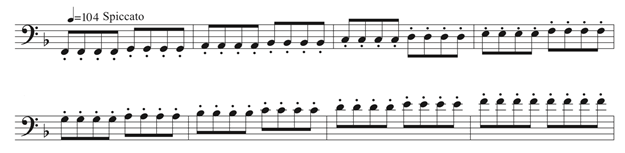
Heath, J. (2006). 165: Ed Barker Interview (from the archives). Contrabass Conversations. View Website
Learning how to prepare for a performance is an important skill for a musician. For this video recording project, you will record yourself playing your jury from start to finish without any stops. You will post the recording to your e-portfolio as an artifact. In preparation for this, please do the following:
How did your mock performance go? Were you satisfied? If not, what changes can you make to be more satisfied with your performance? At this date, it is still possible to make small improvements. Be prepared to discuss some realistic goals in advance of your jury.
Dr. Mark Elliot Bergman is the Director of Strings and Orchestral Studies at Sheridan College and the double bass studio instructor at the University of Wyoming. He teaches double bass, electric bass, cello, viola da gamba, composition, songwriting, and music history. As an ensemble leader, Mark directs the Sheridan College Symphony Orchestra, the Sheridan College Viol Consort, and the professional early music ensemble Wyoming Baroque. He is also the Assistant Principal Double Bassist of the Billings Symphony Orchestra. During the summer, Mark performs with Assisi Performing Arts in Assisi, Italy, and the Peter Britt Festival Orchestra in Jacksonville, Oregon. Mark has an active background as an orchestral double bassist. He is the former Principal Double Bassist of the New Haven Symphony Orchestra and the Mato Grosso Chamber Orchestra in Cuiabá, Brazil. He formerly served as a Professor of Music History and Ensemble Director at George Mason University in Fairfax, Virginia.
With Wyoming Baroque, Mark released three CDs, two featuring his original compositions for historically informed performers. Mark published two books about popular music pedagogy and authored multiple articles selected for publication with the peer-reviewed Online Journal of Bass Research. In 2022, the International Society of Bassists awarded him their Grand Prize in Research for his article about e-portfolio learning. Mark received the 2018 Performing Arts Fellowship from the Wyoming Arts Council to recognize his work as a composer and performer. He earned his doctorate from George Mason University in 2015. He also holds degrees from Yale University, the Eastman School of Music, and the Manhattan School of Music.
© 2003 - 2026 International Society of Bassists. All rights reserved.
Items appearing in the OJBR may be saved and stored in electronic or paper form, and may be shared among individuals for purposes of scholarly research or discussion, but may not be republished in any form, electronic or print, without prior, written permission from the International Society of Bassists, and advance notification of the editors of the OJBR.
Any redistributed form of items published in the OJBR must include the following information in a form appropriate to the medium in which the items are to appear:
This item appeared in The Online Journal of Bass Research in [VOLUME #, ISSUE #] in [MONTH/YEAR], and it is republished here with the written permission of the International Society of Bassists.
Libraries may archive issues of OJBR in electronic or paper form for public access so long as each issue is stored in its entirety, and no access fee is charged. Exceptions to these requirements must be approved in writing by the editors of the OJBR and the International Society of Bassists.
Citations to articles from OJBR should include the URL as found at the beginning of the article and the paragraph number; for example:
Volume 3
Alexandre Ritter, "Franco Petracchi and the Divertimento Concertante Per Contrabbasso E Orchestra by Nino Rota: A Successful Collaboration Between Composer And Performer" Online Journal of Bass Research 3 (2012), <http://www.ojbr.com/volume-3-number-1.asp>, par. 1.2.Volume 2
Shanon P. Zusman, "A Critical Review of Studies in Italian Sacred and Instrumental Music in the 17th Century by Stephen Bonta, Burlington, VT: Ashgate Publishing Co., 2003." Online Journal of Bass Research 2 (2004), <http://www.ojbr.com/volume-2-number-1.asp>, par. 1.2.Volume 1
Michael D. Greenberg, "Perfecting the Storm: The Rise of the Double Bass in France, 1701-1815," Online Journal of Bass Research 1 (2003) <http://www.ojbr.com/volume-1-complete.asp>, par. 1.2.
This document and all portions thereof are protected by U.S. and international copyright laws. Material contained herein may be copied and/or distributed for research purposes only.