Abstract: In the period 1849 -1851, a collection of articles by A. Müller and F.C. Franke appeared in the Neue Zeitschrift für Musik, which discussed various aspects of double bass playing. The two double bassists agreed on some points, including that the double bass has a very important role in the orchestra, that there was a lack of good double bass players at the time, and the general characteristics of a good instrument. But, they debated other subjects, such as playing stance, left hand technique, bow technique, the necessary components of daily practice, and the common practice of simplifying double bass parts. Their discussion on these topics has implications for historically informed performance, especially in regard to the performance of Beethoven's symphonies, while also raising questions regarding technical development that are relevant to modern double bassists who play all styles of music.
August Müller and Friedrich Christoph Franke were two German double bassists in the mid-nineteenth century who were concerned about the state of double bass playing in their time.i While it seems that they never met each other, they did correspond with one another, in a manner of speaking, through articles published in the NZfM.ii These articles appeared in the period from 1848 - 1851 and deal with various subjects related to double bass playing. Franke and Müller's discussion in these articles provides a great deal of insight, not only about nineteenth-century double bass technique, but also about the construction and set-up of instruments, how double bassists were trained, and orchestral performance practices.
August Müller, born in 1808, was a double bassist for the court orchestra at Darmstadt from 1825 until his death in 1867 and eventually rose to the position of its principal double bassist. Müller made his solo debut in Darmstadt in 1836 and soon gained renown performing in London and Paris.iii Between 1847 - 1864 Müller wrote a number of articles for the NZfM, including the extended series, "On the double bass and its use, with regard to the symphonies of Beethoven," which appeared in eight installments between June 1848 and March 1849.iv In his first installment, Müller listed all the existing method books he knew, and this list was essentially responsible for initiating the written debate between himself and Franke.v
Friedrich Christoph Franke was born in 1804 in the town of Sangerhausen and joined the Prussian military in 1821 as a musician in the Alexander-Regiment of Berlin. In 1824, he gained employment as a double bassist in the orchestra of the Königsstädtisches Theater in Berlin, where he performed a self-composed concertino with variations in 1830. Franke became the principal double bassist of the Duke of Anhalt's court orchestra in Dessau in 1834, and later joined the court orchestra in Strelitz.vi His contributions to the NZfM indicate that he stayed in Dessau until at least 1851.vii Franke's method book, Instructions for Playing the Double Bass, was first published in 1845, and later reprinted in 1874.viii
An anonymous letter appeared in the NZfM in October 1848 that inquired why Müller had neglected to include Franke's method book in his list of existing double bass tutors, and invited him to include a discussion of the method in a later article.ix Müller obliged, though his review of Franke's method did not appear until after his series on playing the double bass in Beethoven's Symphonies was completed. Meanwhile, Franke wrote an article in December 1848 that again called attention to the omission of his method, while also highlighting the points in Müller's articles with which he disagreed. After Müller wrote a critical review of the method in June 1849, Franke provided one last rebuttal in January 1851, and this concluded the exchange as far as it was documented in the NZfM.
Franke and Müller's unique dialogue reveals a great deal about the state of double bass playing circa 1850: information that is valuable today to those in the field of historically informed performance, as well as to bassists playing any style of music who are looking to explore non-standard playing techniques as a way of enhancing their performances. While the diversity in historical technique already becomes obvious from looking at various sources that discuss double bass playing from the late-eighteenth to mid-nineteenth centuries, their differences can now only be discussed and evaluated from a modern point of view.x Reading Franke's and Müller's opinions of each other's instructions however, offers a contemporaneous critical review of each author's works. Their discourse yields detailed explanations and justifications, allowing modern players to more deeply understand the two bassists' ideas about playing.
This examination of Franke's and Müller's playing methods will focus primarily on the points about which the two authors disagree and on practices that deviate from modern trends in double bass performance practices. The following subjects will be discussed in roughly the same order in which they appear in Franke's and Müller's own publications: the role of the double bass, the state of double bass playing, characteristics of the instrument, playing stance, left hand technique, bow technique, the components of a practice regimen, and suggestions for performing Beethoven's symphonies. These instructions will be explored in relation to their relevance to modern double bass playing in the contexts of both general playing technique and historically informed performance.
While Franke and Müller disagreed on many points, they were both passionate exponents of the double bass and prefaced their instructions for playing the instrument with a discussion of its importance. In his method, Franke explains that the bass line determines the harmonic progression and thus the intrinsic value of music, and that therefore a good bass section is necessary for the effective execution of a work. He praises the double bass as an instrument with the fullness and majesty of a strong organ pedal, as one that no other instrument can match in its depth and diversity of tone, and as one that is able to equal the nuance in performance of all other instruments.xi Müller puts it more briefly, and states that an orchestral performance in which the bass is poorly heard is "imperfect."xii
That the bass line is the foundation of a piece of music has been a widely accepted rule throughout Western musical history, and sources from the nineteenth century in particular devote paragraphs or even entire sections to describing the double bass's important role in ensemble situations. The German music pedagogue Franz Joseph Fröhlich called a good double bassist the "soul of all music."xiii Johann Joachim Quantz, who though he is most famous for his treatise On Playing the Flute, also studied the double bass and numerous other instruments, and wrote that "many persons do not appreciate how valuable and necessary it is in a large ensemble when [the double bass] is well played. . . . Especially in an orchestra, where one person cannot always see the others or hear them well, the double bass player, together with the violoncellist, forms the point of equilibrium, so to speak, in maintaining the correct tempo."xiv More emphatically, Jacques Claude Adolphe Miné begins his double bass method with the words, "The double bass is the lowest instrument of the orchestra. Its power makes it indispensable for nourishing and binding the masses of harmony found in symphonic music."xv That Franke, Müller and so many others felt the need to include such statements in their discussions of the instrument suggests that perhaps double bassists of the time were inadequately, and noticeably so, performing the role so inherent to their instrument. Further evidence of this deficit appears in Franke's and Müller's writings.
Both Franke and Müller comment resentfully on the apparent lack of good double bass players, and present suspected causes.xvi Each author lists the same primary reasons for this unfortunate deficiency:
Training in double bass playing is not up to the same standards as that of other instruments:
Müller writes that there are no completely sufficient method books or truly capable teachers, and that while some conservatories are in the early stages of attempting to remedy this discrepancy, other institutions do not take enough interest in the double bass.xxii He compares double bass training to the preparation of sourdough bread, in which the same old piece of dough is kept and kneaded for generation after generation.xxiii Franke agrees that there is a lack of good double bass methods, and adds that those that exist are not widely disseminated, which he claims is demonstrated by Müller's unfamiliarity with his method.xxiv
The double bass is not granted enough financial priority:
Franke argues that based mainly on economic grounds, double bass players are not sufficiently trained before they are sent to work in orchestras.xv Müller suggests that a reward should be offered for someone to write a good double bass method, but that he believes that most publishers would not even accept a double bass method for free.xxvi
Franke and Müller are not alone in pointing out the deficiencies of double bassists in the nineteenth century, or in laying the blame on external factors such as instruments or orchestral management. Fröhlich, for example, reprimands orchestras for their destructive habit of employing double bassists who damage the character of the bass line with superficial, cold or tasteless playing.xxvii Hause also notes the scarcity of good method books in the introduction to his own method.xxviii
Franke and Müller both stress that double basses must be constructed with quality materials and the proper proportions. Franke writes that while the size of instruments varies, they must still be proportionate in shape, size, and strength.xxix Müller applies this concept even further to strings. He says that the strings must be the correct distance from the fingerboard and from each other in order to prevent strings from colliding or rattling against the fingerboard while playing forte. Strings should also be the appropriate thickness for the instrument, relative to its size and the thickness of its constitutive wood. He further recommends using Italian-made strings, which he explains are superior to German and French strings because they are made from better materials, and are twisted more tightly, making them more flexible. Lastly, Müller prescribes a metal-wound A string because it is thinner and thus produces a clearer tone than an unwound A string.xxx
Franke and Müller also have similar ideas about what characterizes a good bow, namely, that it should be long and heavy enough to be effective on the very thick strings of the double bass. The two disagree however, on whether it is advantageous to add even more weight to the bow by filling the tip with lead. Franke suggests doing this in his method, and even stands by the idea after Müller states in his review of Franke's method that weighting the tip inhibits easy and free movement.xxxi
While Franke's and Müller's instructions provide a very clear picture of the ideal double bass in accordance with the state of instrumental development at the time, further observations reveal that such instruments were in fact quite rare. Franke remarks that a good instrument and good bow are rarely considered essential for double bass players, and offers this as yet another reason for the subpar performance of double bassists in many orchestras. He argues further that the lack of appreciation for both players and instruments does not inspire young artists to devote themselves to the double bass.xxxii Müller also observes that many orchestras suffer from the employment of mediocre instruments, whose sound is often lost in the orchestra and lacks resonance, or even worse, which produce a "hammering of the strings."xxxiii He writes that double basses crafted by the old Italian masters are rare, and that one usually hears instruments that are made of thin, low-quality wood and have improperly positioned bridges and fingerboards.xxxiv
Franke and Müller each provide instructions for holding the instrument. In his method, Franke describes two methods of standing with the instrument: one for larger players and one for smaller players. His recommended stance for larger people involves standing with the left foot behind the bass at the middle of the instrument, and the right foot a bit forward and turned slightly outward so that the leg makes contact with the edge of the lower bout of the instrument. In this position, Franke instructs the player to support his body weight on his left foot so that he can turn the instrument with his right knee to be able to reach all the strings. To play on the lower strings, the player should turn the bass forward a little and meanwhile lean the body slightly to the right. He warns however, that these movements should not be noticeable to the audience, and that a player's posture should always be upright and at ease. For smaller players, Franke offers a slight variation to this position; the bass should be turned more towards the player, the right foot should support his body weight, and the left foot should be placed behind the instrument in such a way that bending the knee forward slightly turns the instrument, thereby allowing access to all four strings.xxxv
Müller writes that in order to have the same ability as violinists and cellists to move the arms freely while playing, a player must hold the double bass with the inside of the left knee and the upper part of the right calf, with his right foot turned outward.xxxvi He further explains that one must have an endpin that is long enough to allow standing in this position, and also advises bass players to maintain a dignified posture since playing while standing makes them more visible to audiences.xxxvii In reference to Franke's method, Müller states outright that supporting the body on the right foot and leaning to the right to play the lower strings is wrong. According to Müller, a double bass player must always stand up straight and support his weight on his left foot, for if the player supports himself on his right foot, he will lose the freedom to move his right arm. He also advises smaller players to use smaller basses, or to choose another instrument entirely, rather than allowing them to hold the instrument in a different manner as Franke suggests.xxxviii
Neither Franke's nor Müller's suggested manner of holding the bass is popular among performers today. Aside from the fact that many modern double bassists choose to play while sitting, even those who stand would not promote supporting most of the body's weight on one leg, or suggest turning the bass with one's leg when moving from the higher to the lower strings and vice versa. However, some of these methods' principles have survived to the present day: Müller's assertion that one must not hold the double bass up with the left hand, and Franke's observation that how someone holds the double bass depends on the size of both the player and the instrument are still two of the most basic fundamentals of modern double bass technique.xxxix Other aspects of these standing positions may be more specifically applicable to historically informed performers. For instance, it is clear that both Müller and Franke held the bass in a fairly upright position, as their legs would otherwise not be close enough to the instrument to hold it in place and to turn it in order to access all four strings. In such a position, the bow exerts force horizontally across the strings more than down into the strings, a tendency that diminishes if the instrument is positioned at an angle. Historical cello and viola da gamba players also held their instruments fairly upright, a result of holding their instruments in place with their legs since they did not have endpins. The influence of this position on how the bow makes contact with the strings is part of the modern 'HIP' sound, which is commonly described as more open or resonant, but with less projection. Modern 'HIP' double bassists should therefore be cautious if they choose to sit or stand with the bass in a more angled position, and adapt their bowing accordingly.
Perhaps the most extreme contrast between Franke's and Müller's methods lies in their ideas about left hand technique and fingerings. Franke advocates the equal use of all four fingers, while Müller outlines a 3-finger system, which most double bassists today would recognize as standard fundamental technique. When evaluating their arguments, it is important to view these two methods within the context of the development of both the double bass and its playing technique. Methods dating from before Müller and Franke's discussion outline a variety of fingerings. Some employ all four fingers (e.g. Corrette and Miné, though unlike Franke, their methods suggest using either the second or third finger in different situations, instead of using these fingers for consecutive semitones in one position); while others exclude a finger in the lower positions (e.g. Hause and later Simandl, who outline strict 1-2-4 fingerings, and Bonifazio Asioli, who established the Italian 1-3-4 system); and still others use only first and fourth fingers (e.g. Fröhlich, and Giovanni Bottesini at times).xl This last 2-finger, or fisticuff, fingering system was a necessity for playing on thick strings that were strung quite high over the fingerboard; however, as instruments and strings developed, the practice was abandoned early in the nineteenth century.xli
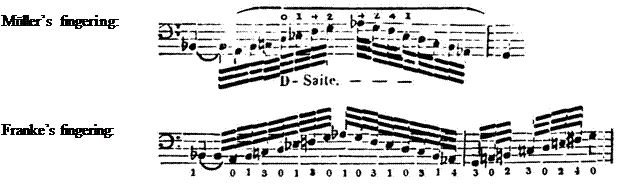
Franke claims that nothing is more natural than being able to reach all the notes between the open strings in one position, and that this yields the most reliable results for executing passagework.xlii Using all four fingers also allows the player to play more notes with fewer shifts, which Franke points out is advantageous even according to Müller's own rules.xliii Franke also implies that 3-finger technique is a byproduct of lower standards, which violinists and cellists would never accept; he asks, "What would you say if a violinist or a cellist would regress to this idea, try to declare a finger disabled and explain that a fingering derived from this is correct and useful?"xliv Franke uses an excerpt from the storm scene of Beethoven's Sixth Symphony to demonstrate the advantages of his fingering system. He provides two fingerings for the excerpt, each of which allows the entire passage to be performed without shifting (see figure 1).
Müller ardently disapproves of Franke's fingering system. He even goes so far as to say that the fingering rules that Franke outlines in his method prove that he does not have an "ex fundamento " understanding of the character of the double bass.xlv Müller argues that one can see by looking at the hand that it is only suited to reach two semitones, and that it is only possible to reach three semitones within one position by stretching out the hand and fingers in an unnatural way that weakens the hand. He goes on to say that the third finger is not an independent finger and should therefore only be used in conjunction with another finger. This finger is more useful when it supports the fourth finger, which is naturally weaker than the second.xlvi As an exception, Müller prescribes the use of the third finger in two situations: when playing whole-tone trills, for which he says using the whole hand would be too cumbersome; and to play the notes that lie one octave above each open string because the fourth finger is too short to reach them.xlvii
Figure 1. Franke's fingering options for Beethoven, Symphony no. 6, movt. 4, mm. 41 - 43.xlviii
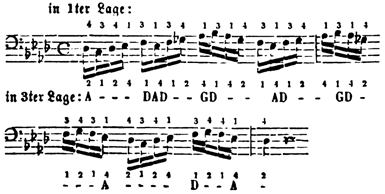
While Müller does not include the excerpt from the Sixth Symphony discussed above in his collection of articles on playing Beethoven's symphonies, his most likely choice of fingering can be extrapolated from the rules and examples he presents in his articles (see figure 2). If one uses the conventional 3-finger system advocated by Müller, it is not possible to play more than three or four consecutive notes without shifting, and sometimes only one note lies between two shifts. Whether this fingering or Franke's expends less energy is largely a matter of personal preference, and depends on various factors. Someone with a relatively broad hand or long fingers might be able to execute Franke's fingerings with little trouble, while someone with a smaller hand might prefer shifting over stretching to reach notes. Moreover, training will have an impact on preference as well. Those who have learned the modern technique known as pivoting to expand their reach within a single position, and who use all four fingers independently, would prefer Franke's fingering; while players who never use the third finger in the lower positions would likely struggle to suddenly incorporate it in this passage. Nevertheless, it is not necessary to adhere to one method just because it is the most familiar. Double bassists who practice both systems, as well as other non-conventional fingerings, have the advantage of being able to choose whichever fingering is most useful in any given situation.
Figure 2. Fingering Müller would likely choose for Beethoven, Symphony no. 6, movt. 4, mm. 41 - 43. Shifts are indicated by a slash ( / ).xlix

Though Müller's fingering system more closely reflects standard modern technique, he provides the rather questionable justification that double bassists have already learned how to execute all the difficult passages they might come across with the 3-finger method.l Unfortunately for Müller, this argument contradicts his earlier complaint that double bass training is like old sourdough that is made into loaf after loaf of the same bread, instead of developing and progressing. Franke also criticizes Müller's reasoning and maintains that using the third finger does not reduce clarity in fast passages.li There is no way to definitively prove that one method or the other is more 'correct' for every bass, player, and situation. Whether dealing with the twenty-first, nineteenth, or any other century, double basses come in a variety of sizes, with diverse set-ups; and players have different hand sizes, as well as varying levels of agility, flexibility, strength, and coordination: factors which lead them to prefer different fingering systems.
Another dispute regarding left hand technique has to do with how the fingers contact the string. Franke writes that double bassists should not play on their fingertips as violinists do, but should instead extend the first segment of the finger and place it firmly on the string so that it cannot escape and gives a pure and melodious sound. Franke also indicates that the first segment of the thumb should be applied to the neck as a counter pressure, more or less across from the position of the middle finger.lii
Müller disagrees and bluntly states that Franke's method is wrong, and that the strings should be depressed with the meatiest part of the finger, which is something in between playing on the very tips, as violinists do, and laying the finger across the string as Franke suggests. He also rejects Franke's prescribed placement of the left thumb, stating that the first joint of the thumb should be placed on the right side of the neck.liii
Franke responds that his and Müller's suggested hand positions are essentially the same because the difference in the position of the thumb and fingers is hardly more than the width of a hair.liv It is indeed possible that Franke's and Müller's finger placements are in fact almost identical, and that the two simply interpret the terminology differently, specifically with regard to what it means to 'lay' the finger across the string. Their opinions on the matter of thumb placement differ more clearly. Müller's method of placing the first knuckle of the thumb on the right side of the neck puts the neck more deeply into the hand than Franke's method of placing only the tip of the thumb behind the neck.
From these descriptions alone, since diagrams or illustrations are absent in both sources, it seems that Franke's hand position reflects what most modern bassists would consider proper technique. However, his statement that the thumb applies a counter pressure goes against the currently prevailing rule that in order to prevent injury, the thumb should be relaxed and the strings should be depressed by the weight of the player's hand and arm — and not by pressing the fingers down, holding the instrument with the thumb, or using any significant muscular force.
Franke and Müller each adamantly contend that their own way of holding the bow is correct and that the other's is unnatural, though they follow the same fundamental principles and differ only slightly in mechanics. Both Müller and Franke describe an underhand (German) bow hold with the thumb placed over the stick, one finger serving to direct the stick, and two fingers placed in the frog. This leaves one finger without a clear purpose, which leads to the discrepancy that arises between their two holds.
Franke chooses to place the little and ring fingers in the frog and uses the middle finger to direct the bow, which leaves the index finger free to rest somewhere between the middle finger and thumb while providing support.lv Müller, on the other hand, uses the index finger to direct the bow, places the middle and ring fingers in the frog, and leaves the little finger free to settle under the frog.lvi
Müller calls Franke's bow hold "unnatural" and "forced" because it causes the weight of the hand to fall mostly on the stick rather than the frog, which Müller claims causes the player to "hack" and "saw" with the bow.lvii Franke counters this statement by listing five objections to Müller's method:
In practice, the primary difference between the two methods is that Müller's bow hold creates the sense of holding the frog, while Franke's feels like holding the stick. Modern bow holds follow Franke's example in this respect, and give one the sense of holding the stick more than the frog. That being said, since the frogs of modern German bows are generally shorter than those in Müller and Franke's time and thus lack the space for two fingers, most modern methods involve placing the index and middle fingers on the stick, the ring finger in the frog, and the little finger underneath the frog, which can perhaps be seen as an amalgamation of Franke's and Müller's bow holds.
Müller also criticizes some of Franke's instructions for different bow strokes. While Franke writes in his method that one performs staccato by lifting the bow from the string between notes, Müller insists that the bow must stay on the string during the short pause between notes in order to keep the string from ringing, and to prepare for the next stroke. According to Müller, a bouncing bow is only used for fast repeated notes in piano.lix Franke readily accepts this correction, but is less forgiving of Müller's comment that his instructions for col legno should have been omitted because the technique is "unpoetic" and outdated.lx Franke defends himself by saying that col legno is an existing expression, and is therefore rightfully included in his method.lxi
Both authors advise a method of practice meant to help aspiring double bass students rise to a professional level of performance. Franke's method book provides a detailed guide to this training and includes exercises in every key, for all types of bowings, and in various styles. He also includes examples from the orchestral repertoire, and sections on ornamentation and accompanying recitatives. In his review, Müller commends the method for having good exercises that are presented in a reasonable order, and that address the various aspects of playing. He also compliments in particular the sections on supplementary subjects such as ornamentation, compositional styles, and accompanying recitatives; the latter of which, he states, no one else has written about before.lxii
Though Müller did not write a method in a traditional format, he nonetheless includes suggestions for a routine of daily practice in the second installment of his extended article; Müller's routine consists of:
Franke writes that Müller's routine is too limited, and suggests adding both exercises in fourths, fifths and sevenths, as well as more bowing styles than just slurs.lxiv While the addition is not extreme, it does indicate that Franke has a more technical approach to double bass playing than Müller, the latter of whom speaks more about the value of strength and dependability in players.
Roughly two thirds of the content of Müller's "On the double bass and its use" covers playing Beethoven's symphonies. Müller systematically discusses each symphony, and includes both general advice and instructions for specific excerpts from each of the nine symphonies. Although Müller calls Beethoven's symphonies a "true treasure for the development of double bassists," he also criticizes the composer for overestimating human strength and not always considering the range and mechanics of the instrument, as evidenced by passages in Beethoven's symphonies that are too low or excessively difficult.lxv He claims that to be able to perform the Ninth Symphony, a double bassist must have the strength of Polyphemus and the technical abilities of Paganini.lxvi
In many places, Müller advises either transposing complete or partial passages up one octave so that they sound in the same octave as the cellos, or simplifying fast passages by playing longer note values and leaving the shorter notes in between to the cellos. According to Müller, these changes are necessary either to compensate for composers' disregard for the double bass's playing range, or for the sake of clarity. His remaining instructions include fingering and bowing recommendations and other practical advice. Müller also lists four main principles for successfully performing Beethoven's symphonies:
Franke is less readily willing than Müller to depart from what the composer has written. He acknowledges that many composers do not heed the double bass's playing range, but he opposes transposing for any other reason or simplifying fast passages. These changes are not up to the performer, he writes, but rather to the conductor, who is solely responsible for the intentions of the composer.lxviii As an example, Franke refers to Müller's modifications of two excerpts from Beethoven's Fifth Symphony.
Müller transposes the motive that occurs in mm. 44 - 45 of the fourth movement of Beethoven's Fifth Symphony up one octave, and instructs that the high A should be executed as a harmonic on the D string, which allows the entire passage to be played with only one shift between the fourth and fifth notes (see figure 3). Müller states that since this motive is played only by the bass instruments, it should be heard very clearly, and that the low notes and quick string crossings required to execute the passage in its original form make it unclear.lxix
Figure 3. Müller's modification of Beethoven, Symphony no. 5, movt. 4, mm. 44 - 45.lxx
| Beethoven's version: | Müller's modification: |
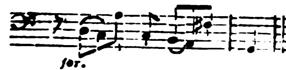 |
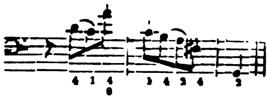 |
Müller claims that the passage occurring in mm. 80 - 90 of the same movement should be reduced in order to conserve energy (see figure 4), but Franke opposes the simplification and states that the several indiscriminate changes that Müller suggests cannot be allowed.lxxi This disagreement again demonstrates the difference between the two players' concepts of double bass playing: Müller is concerned with stamina and having enough strength for a solid performance, and will cut out notes to achieve this end; while Franke adheres more closely to the prescribed notes, and is more optimistic about double bassists' stamina and technical abilities. Unfortunately, one can only speculate about whether Franke and others who followed his line of thought were successful in faithfully performing the written parts as powerfully as Müller and his fellow simplifiers.
Figure 4. Müller's reduction of Beethoven, Symphony no. 5, movt. 4, mm. 80 - 90.lxxii
Beethoven's version (mm. 80 - 85):
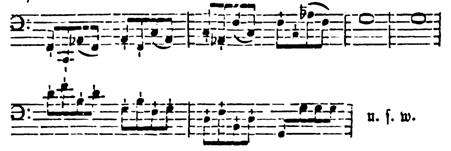
Müller's reduction (mm. 80 - 90):
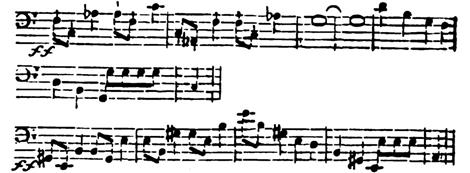
Some of Franke's objections stem from the two bassists' contradicting ideas about fingering. In general, Müller's fingerings require more shifting and avoid open strings whenever possible, while Franke's fingerings utilize open strings in order to avoid shifting. An example of their differing preferences can be seen in mm. 16 - 17 of the first movement of the Second Symphony (see figure 5). Müller permits the open D in order to facilitate the required crescendo, but then continues up the D string with a closed G.lxxiii Franke however suggests playing the entire passage in one position with the G and A-flat on the G string, though he also instructs that the open strings be played with the proper tone color.lxxiv
Figure 5. Fingerings for Beethoven, Symphony no. 3, movt. 1, mm. 16 - 17.lxxv
Franke seems to misinterpret some of Müller's fingering suggestions, for he claims that Müller at times indicates reaching a minor third in one position: a span that is possible using Franke's system, but not Müller's. In each case however, the fingerings that Müller writes can in fact be executed using his own 3-finger system. The three examples that Franke sets forth are from the first movement of the Third Symphony, the third movement of the Fourth Symphony, and the fourth movement of the Sixth Symphony.
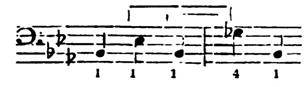
Franke apparently assumes that the minor thirds in these examples are intended to be executed without shifting, which he supports by quoting Müller's statement, "This shift, because it generates clumsy playing, is always reprehensible!"lxxvi However, referring to the quote in its original context in Müller's article reveals that Franke has misinterpreted Müller's words. Müller is not referring to shifting in general here, but rather specifically to shifting from one note to another with the fourth finger. That being the case, shifting from first finger on E-flat to fourth finger on G-flat, as Müller indicates for mm. 346 - 347 of the first movement of the Third Symphony, would be perfectly acceptable (see figure 6).
Figure 6. Müller's fingering for Beethoven, Symphony no. 3, movt. 1, mm. 346 - 347.lxxvii
Franke's next example, mm. 6 - 9 of the third movement of the Fourth Symphony, also suffers from missing information. The example shown comes from Müller's article (see figure 7), while Franke's version does not contain Müller's fingerings or string indications, and is truncated to the first beat of m. 8. Franke therefore only shows the descending minor thirds of G-flat to E-flat and C to A, which he hopes to convince readers should be played in a single 4-finger position, while in fact Müller clearly indicates that a great deal of shifting is necessary. According to Müller, the first four notes spanning a major sixth are all to be played on the D string, which requires shifting between each note; and the last four notes are to be executed in two positions on the A string. As Müller explains, one would have to shift numerous times anyway, and this rather unorthodox fingering at least helps one to achieve an even tone and calm bow because it avoids too many string crossings.lxxviii
Figure 7. Müller's fingering for Beethoven, Symphony no. 4, movt. 3, mm. 6 - 9.lxxix
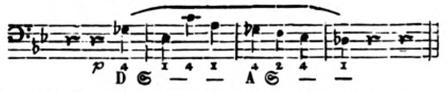
In reference to the excerpt that begins in m. 64 of the fourth movement of the Sixth Symphony, Franke adds that he does not know of a rule that allows for the second finger to play the C-sharp, and that the third finger should be used instead (see figure 8).lxxx While the third finger would be logical for someone using all four fingers, in the 3-finger system one would most likely shift from first finger B to second finger C-sharp so that the D could then be played with the fourth finger, thereby avoiding the 'reprehensible' fourth-to-fourth finger shift from C-sharp to D.
Figure 8. Müller's fingering for Beethoven, Symphony no. 6, movt. 4, m. 64.lxxxi

While Franke does not comment on Müller's other suggested simplifications, two excerpts from the Sixth Symphony do prompt additional consideration. First, in the fourth movement Müller reduces the recurring figure that first appears in mm. 21 from sixteenth notes to eighth notes (see figure 9). He suggests that the double basses only play the notes that outline the harmony — while the cellos play the full motive — because continuously playing such loud and fast notes would result in a mess.lxxxii A common opinion among modern bassists, however, is that this particular passage is actually allowed, or even intended, to be somewhat 'messy' to create an effect. This movement of the symphony is titled "thunderstorm," and the fast, loud, low, and slurred notes played by the cellos and basses in this passage are thought to depict thunder. Müller's reduction makes the figure easier to perform, but it may also reduce the passage's resemblance to rumbling thunder. Nevertheless, a programmatic work can suggest an idea without exactly imitating its sound; Beethoven himself described his symphony as "more sentiment than tone painting," perhaps indicating that performers should aim to evoke the emotions associated with experiencing a thunderstorm rather than attempt to imitate its sound.lxxxiii
Figure 9. Müller's reduction of Beethoven, Symphony no. 6, movt. 4, mm. 21 - 22. Müller notates Beethoven's version with stems pointing up, and his own suggested modification with stems pointing down.lxxxiv

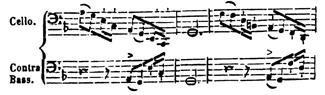
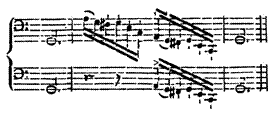
Müller's suggested modification of mm. 43 - 50 of theSixth Symphony is unique in that he suggests changes to a section in which Beethoven has already given the cellos and double basses independent parts (see figure 10). Müller reasons that transposing the lower notes up an octave improves clarity in the passage, and he confidently proclaims that Beethoven himself would approve of this change.lxxxv However, there are some indications that Beethoven had a very specific double bass part in mind in this section, and that the composer was perhaps even trying to avoid the modifications that Müller suggests.lxxxvi It was common practice in Beethoven's time — when a single part was usually written for the cellos and double basses — for double bassists to transpose any notes that fell below the range of their instrument (in Müller's case, a notated E). The transposition was generally applied to a whole passage in order to preserve its contour: in other words, to avoid breaking up the musical line.lxxxvii According to this rule, it would be logical to transpose the entire motive in question as Müller does, in order to maintain the same contour in both the double bass and cello parts. In this case however, Beethoven writes the passage so that the double basses enter an octave below the cellos, and then he breaks the double bass line so that only the last two sixteenth notes of the motive are played in unison with the cellos. If Beethoven expected double bassists to be inclined to transpose the motive from the beginning, he may have created a separate double bass part to indicate that the double basses should not follow common performance practices in this instance.
Figure 10. Müller's modification of Beethoven, Symphony no. 6, movt. 5, mm. 43 - 48.lxxxviii
Original:

Müller's suggestion:
As highlighted by the example above, the matter of when and how to modify double bass parts in nineteenth-century orchestral works is complex. Beethoven's symphonies are among the earliest orchestral works to include sections with independent double bass parts, and early-nineteenth century double bassists would have seen these parts as unique. Criticisms of 'simplifiers' suggest that nineteenth-century composers may have started writing separate double bass parts as an attempt to discourage undesirable modifications.lxxxix Even with independent parts, some double bassists who were used to simplifying their parts would likely have continued the practice out of habit. It appears that Müller was one of those performers who adhered to the old tradition, while Franke was more inclined to follow the developing trends in compositional and performance practices.
Müller's and Franke's articles reveal a great deal, not only about double bass playing in the mid-nineteenth century, but also about the two musicians themselves. Although little information is available about Franke's level of prestige or influence during his lifetime, his method and the two articles he authored in NZfM demonstrate that he was an experienced double bassist and active as an advocate of this somewhat neglected instrument. Franke's guidelines reflect a very idealistic view of double bass playing: he based his fingering system on convenience for the instrument's tuning and he believed that double bassists can use all four fingers just as the other string players do; he maintained that double bassists must play their part as it was written, unless the notes fall below the instrument's range; and rather than deny smaller people the opportunity to play double bass, he described a different way for them to hold the instrument.
While available documentation seems to suggest that Müller was better known than Franke, the former was more cautious in promoting his instrument's technical potential. Müller insisted that the human hand is only capable of reaching two semitones in one position; he advised the simplification of bass parts that he felt were too difficult to execute well; and he warned smaller people to stay away from the double bass and choose another instrument. Müller was also somewhat fixated on the physically arduous nature of the instrument. His articles on playing Beethoven's symphonies repeatedly warned players to conserve their strength, and the issue is central to an additional article he wrote for the NZfM years later.xc Müller was even praised for his secure and not overly technical approach to playing by composer Hector Berlioz, who wrote, "Without trying, as he easily might, to execute turns and trills of needless difficulty and grotesque effect, he makes this enormous instrument sing out broadly and grandly, drawing forth tones of the greatest beauty, which he shades with much art and feeling."xci
In context of the development of double bass playing, it is understandable that Müller's simple yet solid playing was more popular than Franke's more complex and demanding method during their time. As a result of double bassists not being particularly respected, the instrument's technical capabilities were generally still quite basic, and apparently lagged behind those of other instruments. Therefore, many double bassists may have lacked the dexterity to implement Franke's fingering system or to execute difficult passagework in its original form. Rather than striving for and falling short of the seemingly unattainable ideal of technical mastery, many conductors, teachers and performers concentrated on the double bass's role of setting the harmonic foundation in orchestral music. This more conservative approach would have afforded a greater rate of success for musicians of average professional aptitude who were engaged as the double bassists in many orchestras.
A number of double bassists who lived in the nineteenth century transcended the technical difficulties of their instrument and earned renown for their talents. The most famous examples are of course Domenico Dragonetti (1763-1846) and Giovanni Bottesini (1821-1889), whose performances and compositions for double bass demonstrated the instrument's virtuosic capabilities. Though much of Franke's life remains a mystery, his method and articles suggest that he at least recognized a higher technical potential in the double bass than many musicians of his time. In his method book Franke claims that he "grew up behind the double bass," and he may indeed have achieved a much higher technical level than most double bassists as a result of spending his entire life devoted to the instrument.xcii It is feasible that, as a true master of the instrument, he could both employ a 4-finger system that most other double bassists would find too physically exhausting, and precisely and clearly execute fast passage work in the orchestral repertoire that many other performers would need to simplify. The only other possible explanation for his writings could be that he was tenaciously idealistic about the possibilities of the double bass and perhaps a bit delusional about his own abilities. The more likely scenario though, is that he was a lesser-known talent in his day who has now all but been forgotten. Fortunately, his efforts to promote and defend his method in the NZfM have preserved his legacy, allowing later generations of double bassists to reevaluate his ideas, many of which it seems were not widely accepted during his lifetime.
The depth of Franke and Müller's discussion brings up issues of fingering choices that are relevant to modern performers of all styles. The methods that many bass players use today were either written in the late nineteenth century (much closer to Franke and Müller's time than the present day), or are directly based on those methods.xciii In this period, instruments were still set up with gut or sometimes silk strings, which played quite differently than modern strings made primarily of metal. This calls into question how Simandl's fingering system is still the prevailing standard in double bass technique after 140 years of technical development and the eventual transition to steel strings. Fisticuff technique, in essence a 2-finger system with even less possibility for dexterity, died out as strings developed and instruments became more playable. As such, a reconsideration of fingerings would be expected to occur alongside the further evolution of string technology. Instead, the 3-finger 'Simandl' system remains widely accepted as standard, while deviations from this system are now generally viewed as advanced or non-traditional techniques.
Müller and Franke's written discourse about the double bass, which appeared in the Neue Zeitschrift für Musik between 1849 - 1851, provides a uniquely in-depth source on the values and circumstances that influenced double bass playing in the mid-nineteenth century. Modern 'HIP' performers can use these articles to explore how historical techniques can be used to enhance historically informed performance, especially in regard to the practice of simplifying double bass parts in orchestral music. These and other early sources also highlight the wide variety of fingering systems that existed before Simandl technique became the predominant standard as it remains today. Modern performers of all styles should question why fingering technique did not keep evolving alongside string technology, and are encouraged to explore the advantages and disadvantages of Franke's 4-finger system in conjunction with other fingering techniques. Additionally, while Franke's ideas have been briefly referenced in modern artistic research, newly rediscovered information about his career grants him a rightful place on the list of important historical double bassists.
Although Müller and Franke discuss their own performance values and playing methods in great detail, they are just two of many perspectives of historical double bass performance practices. Although I chose to focus on how their ideas compared to each other, there is even more to be learned from examining their methods relative to sources from other regions and periods. As primarily orchestral double bassists, Müller and Franke do not delve into the subject of melodic or solo playing, and thus omit topics that would be hard to avoid in a method for solo playing, but that are perhaps less essential to the double bass's orchestral role: topics including thumb position, alternative tunings, and stylistic elements such as vibrato, portamento, and rubato are not discussed by either author, and therefore need to be explored through other sources. The practice of modifying double bass parts also warrants further examination, as the process certainly evolved throughout history as scoring became more specific. Double bassists performing baroque basso continuo parts, those performing Classical symphonies with a single part for the cellos and double basses, and those performing an independent double bass part in Romantic or later works, all faced different expectations from composers, conductors and performing colleagues regarding their degree of faithfulness in executing their parts as written.
One of the unexpected results of this research is an increased awareness of individual performers' personalities and their role in the development of double bass performance practices throughout music history. Müller's and Franke's writings are an ideal reference for this topic not only because they demonstrate pronounced differences in opinion between two musicians who were active in the same period and working in reasonable proximity to one another, but also because they happened to be some of the last sources published prior to the ever popular Simandl method, which in a way marks the beginning of modern double bass playing. Motivated by a century of developing albeit insufficient methods, yet still free from the influence of widely standardized technique, Müller and Franke represent a critical point in the double bass's pedagogical history.
Franke, F.C. Anleitung den Contrabass zu spielen. Chemnitz: J.G. Häcker, 1845. Accessed August 1, 2014. http://www.mdz-nbn-resolving.de/urn/resolver.pl?urn=urn:nbn:de:bvb:12-bsb10497336-0.
Müller, August. "Tabletten eines Contrabassisten." Neue Zeitschrift für Musik 27, no. 52 (December 25, 1847): 309-310. Accessed August 13, 2014. https://archive.org/details/NeueZeitschriftFuerMusik1847Jg14Bd27.
Müller, August. "Ueber den Contrabaß und dessen Behandlung, mit Hinblick auf die Symphonien von Beethoven." Neue Zeitschrift für Musik 28, no. 45 (June 3, 1848): 265-267. Accessed July 15, 2014. https://archive.org/details/NeueZeitschriftFuerMusik1848Jg15Bd28.
Müller, August. "Ueber den Contrabaß und dessen Behandlung, mit Hinblick auf die Symphonien von Beethoven. (Zweiter Artikel)" Neue Zeitschrift für Musik 29, no. 29 (October 7, 1848): 161-166. Accessed July 15, 2014. https://archive.org/details/NeueZeitschriftFuerMusik1848Jg15Bd29.
"Anfrage" Neue Zeitschrift für Musik 29, no. 30 (October 10, 1848): 179. Accessed July 15, 2014. https://archive.org/details/NeueZeitschriftFuerMusik1848Jg15Bd29.
Müller, August. "Erwiderung." Neue Zeitschrift für Musik 29, no. 38 (November 7, 1848): 224. Accessed July 15, 2014. https://archive.org/details/NeueZeitschriftFuerMusik1848Jg15Bd29.
Franke, F.C. "Bemerkungen zu dem Aufsatze in dies. Zeitschr., Band 28. Nr. 45: Ueber den Contrabaß und dessen Behandlung, mit Hinblick auf die Symphonien von Beethoven, von Aug. Müller, und dessen zweiten Artikel, Band 29. Nr. 29." Neue Zeitschrift für Musik 29, no. 47 (December 9, 1848): 272-275. Accessed July 15, 2014. https://archive.org/details/NeueZeitschriftFuerMusik1848Jg15Bd29.
Müller, August. "Ueber den Contrabaß und dessen Behandlung, nebst einem Hinblick auf die Symphonieen von Beethoven. (Dritter Artikel und Schluß)" Neue Zeitschrift für Musik 30, no. 2 (January 4, 1849): 9-11. Accessed July 15, 2014. https://archive.org/details/NeueZeitschriftFuerMusik1849Jg16Bd30.
Müller, August. "Ueber den Contrabaß und dessen Behandlung, nebst einem Hinblick auf die Symphonieen von Beethoven. (Fortsetzung)" Neue Zeitschrift für Musik 30, no. 3 (January 8, 1849): 15-18. Accessed July 15, 2014. https://archive.org/details/NeueZeitschriftFuerMusik1849Jg16Bd30.
Müller, August. "Ueber den Contrabaß und dessen Behandlung, nebst einem Hinblick auf die Symphonieen von Beethoven. (Fortsetzung)" Neue Zeitschrift für Musik 30, no. 5 (January 15, 1849): 28-32. Accessed July 15, 2014. https://archive.org/details/NeueZeitschriftFuerMusik1849Jg16Bd30.
Müller, August. "Ueber den Contrabaß und dessen Behandlung, nebst einem Hinblick auf die Symphonieen von Beethoven. (Fortsetzung)" Neue Zeitschrift für Musik 30, no. 13 (February 12, 1849): 65-67. Accessed July 15, 2014. https://archive.org/details/NeueZeitschriftFuerMusik1849Jg16Bd30.
Müller, August. "Ueber den Contrabaß und dessen Behandlung, nebst einem Hinblick auf die Symphonieen von Beethoven. (Fortsetzung)" Neue Zeitschrift für Musik 30, no. 15 (February 19, 1849): 82-83. Accessed July 15, 2014. https://archive.org/details/NeueZeitschriftFuerMusik1849Jg16Bd30.
Müller, August. "Ueber den Contrabaß und dessen Behandlung, nebst einem Hinblick auf die Symphonieen von Beethoven. (Schluß)" Neue Zeitschrift für Musik 30, no. 21 (March 12, 1849): 109-113. Accessed July 15, 2014. https://archive.org/details/NeueZeitschriftFuerMusik1849Jg16Bd30.
Müller, August "F. C. Franke's Anleitung den Contrabass zu spielen." Neue Zeitschrift für Musik 30, no. 45 (June 4, 1849): 243-246. Accessed July 15, 2014. https://archive.org/details/NeueZeitschriftFuerMusik1849Jg16Bd30.
Müller, August. "Ueber das Wirken des Musikers im Orchester." Neue Zeitschrift für Musik 31, no. 41 (November 18, 1849): 217-219. Accessed August 13, 2014. https://archive.org/details/NeueZeitschriftFuerMusik1849Jg16Bd31.
Müller, August. "Ueber das Wirken des Musikers im Orchester. (Schluß)" Neue Zeitschrift für Musik 31, no. 43 (November 25, 1849): 229-230. Accessed August 13, 2014. https://archive.org/details/NeueZeitschriftFuerMusik1849Jg16Bd31.
Franke, F.C. "Ueber den Contrabaß." Neue Zeitschrift für Musik 34, no. 3 (January 17, 1851): 29-32. Accessed August 1, 2014. https://archive.org/details/NeueZeitschriftFuerMusik1851Jg18Bd34.
Müller, August. "Der Contrabassist als Arbeiter." Neue Zeitschrift für Musik 57, no. 25 (December 19, 1862): 225-226. Accessed August 13, 2014. https://archive.org/details/NeueZeitschriftFuerMusik1862Jg29Bd57.
Müller, August. "Ein guter Contrabaß." Neue Zeitschrift für Musik 60, no. 13 (March 25, 1864): 108. Accessed August 13, 2014. https://archive.org/details/NeueZeitschriftFuerMusik1864Jg31Bd60.
Asioli, Bonifazio. Elementos para el Contrabajo, con un nuevo modo de hacer uso de los dedos. Translated into Spanish by Mariano Herrero y Sessé. Manuscript. Milan: c.1873. Accessed November 24, 2014. http://bdh.bne.es/bnesearch/detalle/bdh0000158396.
Bach, Johann Sebastian. St. Matthew Passion. Edited by Alfred Dürr. Urtext Study Score. Kassel: Bärenreiter, 1974.
Beethoven, Ludwig van. Beethoven, the Man and the Artist as Revealed in his own Words. Edited by Friedrich Kerst and Henry Edward Krehbiel. Project Gutenberg, 2002. Accessed December 6, 2014. http://www.gutenberg.org/ebooks/3528.
Beethoven, Ludwig van. Symphony No. 6. Manuscript. From International Music Score Library Project, Petrucci Music Library. Accessed September 15, 2014. http://imslp.org/wiki/Special:ReverseLookup/46098
Berlioz, Hector. Autobiography of Hector Berlioz, member of the Institute of France, from 1803 to 1865. Comprising his travels in Italy, Germany, Russia, and England. Volume 2. Translated by Rachel Holmes and Eleanor Holmes. London: Macmillan & co., 1884). Accessed August 25, 2014. http://www.archive.org/details/autobiographyof02berl.
Bottesini, Giovanni. Grande Méthode Complète de Contrebasse. Paris: Escudier, c. 1869. Accessed July 1, 2014. http://imslp.org/wiki/Special:ReverseLookup/254239
Brun, Paul. A New History of the Double Bass. Villeneuve d'Ascq: Paul Brun Productions, 2000.
Corrette, Michel. Méthodes pour apprendre àjouer de la contrebasse à3, à4, et à5 cordes, de la quinte ou alto et de la viole d'Orphee: Réimpression de l'édition Paris, 1781. Geneva: Minkoff Reprint, 1977.
Dalla Torre, Silvio. BASSics: Basics of the Four-Finger-Technique for Playing the Double Bass According to the "New Dutch School." Rostock: Sidatoverlag, 2004.
Dalla Torre, Silvio. "Two, Three, or Four Fingers." Accessed September 25, 2014. http://silviodallatorre.com/index.php?language=en&hauptrubrik=double-bass&ebene=2&thema=6.
Fröhlich, Franz Joseph. Vollständige Theoretisch-praktische Musikschule. Bonn: N. Simrock, 1811. Accessed July 1, 2014. http://reader.digitale-sammlungen.de/resolve/display/bsb10527195.html.
Hause, Wenzeslas. Méthode Complette de Contrebasse. Mainz: Schott, 1826.
Hofmeister XIX. Accessed January 17, 2015. http://hofmeister.rhul.ac.uk.
Ledebur, Carl Freiherrn von. Tonkünstler-Lexicon Berlin's: von den ältesten Zeiten bis auf die Gegenwart. Berlin: Ludwig Rauh, 1861. Accessed January 1, 2015. https://archive.org/details/tonknstlerlexi00lede.
Miné, Jacques Claude Adolphe. Methode de Contre-Basse. Paris: A. Meissonier, c. 1830. Accessed July 1, 2014. http://gallica.bnf.fr/ark:/12148/btv1b52501989f.
Petracchi, Franceso. Simplified Higher Technique. London: Yorke Edition, 1982.
Pinca, Massimo. "August Müller's Contributions to the Neue Zeitschrift für Musik (1848-1849): Evidence of Approaches to Orchestral Double Bass Playing in the mid-19th Century." Ad Parnassum, A Journal of Eighteenth- and Nineteenth-Century Instrumental Music 12, no. 23 (April 2014): 15-59.
Rabbath, François. Art of the Left Hand. Directed by Hans Sturm. Muncie, IN: Ball State University/Avant Bass, 2010. DVD.
Rabbath, François. Nouvelle Technique de la Contrabasse. Vol. 3. Paris: Alphonse Leduc, 1984.
Review of "F. C. Franke, Anleitung den Contrabass zu spielen." Neue Zeitschrift für Musik 22, no. 43 (May 28, 1845): 177. Accessed July 15, 2014. https://archive.org/details/NeueZeitschriftFuerMusik1845Jg12Bd22.
Simandl, Franz. New Method for the Double Bass. New York: Carl Fischer, 1904. Accessed July 1, 2014. http://imslp.org/wiki/Special:ReverseLookup/272043
Quantz, Johann Joachim. "Chapter 17, Section 5: Of the Double Bass Player in Particular." In On Playing the Flute. 2nd ed. Translated by Edward R. Reilly. London: Faber & Faber, 1985.
Unless otherwise noted, foreign language texts that are quoted or paraphrased in this paper have been translated into English by the author. See appendix for original text and translations.
i Silvio Dalla Torre, "Two, Three, or Four Fingers," http://silviodallatorre.com/index.php?language=en&hauptrubrik=double-bass&ebene=2&thema=6. Dalla Torre's article seems to be the only source that gives the full name Friedrich Christoph Franke. Franke is listed as "F. Christoph Francke" in Carl Freiherrn von Ledebur, Tonkünstler-Lexicon Berlin's: von den ältesten Zeiten bis auf die Gegenwart (Berlin: Ludwig Rauh, 1861), 161, https://archive.org/details/tonknstlerlexi00lede; All other sources, including Franke's own publications, include only the initials F.C.
ii See bibliography for chronological listing of Franke's and Müller's publications.
iii Massimo Pinca, "August Müller's Contributions to the Neue Zeitschrift für Musik (1848-1849): Evidence of Approaches to Orchestral Double Bass Playing in the mid-19th Century," Ad Parnassum, A Journal of Eighteenth- and Nineteenth-Century Instrumental Music 12, no. 23 (April 2014): 17-19.
iv German title: "Ueber den Contrabaß und dessen Behandlung, mit Hinblick auf die Symphonien von Beethoven." Divided across eight issues of the Neue Zeitschrift für Musik : vol. 28, no. 45 (June 3, 1848); vol. 29, no. 29 (October 7, 1848); vol. 30, no. 2 (January 4, 1849), no. 3 (January 8, 1849), no. 5 (January 15, 1849), no. 13 (February 12, 1849), no. 15 (February 19, 1849), no. 21 (March 12, 1849).
v August Müller, "Ueber den Contrabaß und dessen Behandlung, mit Hinblick auf die Symphonien von Beethoven," Neue Zeitschrift für Musik 28, no. 45 (June 3, 1848): 267, https://archive.org/details/NeueZeitschriftFuerMusik1848Jg15Bd28.
vi Ledebur, 161.
vii Franke signs off his 1851 article with, "F.C. Franke, herz. Dessauischer Kammermusikus." F.C. Franke "Ueber den Contrabaß," Neue Zeitschrift für Musik 34, no. 3 (January 17, 1851): 32, https://archive.org/details/NeueZeitschriftFuerMusik1851Jg18Bd34.
viii Hofmeister XIX, http://hofmeister.rhul.ac.uk: March 1845 (p. 34) & February 1874 (p. 19).
ix "Anfrage," Neue Zeitschrift für Musik 29, no. 30 (October 10, 1848): 179, https://archive.org/details/NeueZeitschriftFuerMusik1848Jg15Bd29.
x For a representative sampling, see Michel Corrette, Méthodes pour apprendre àjouer de la contrebasse à3, à4, et à5 cordes, de la quinte ou alto et de la viole d'Orphee: Réimpression de l'édition Paris, 1781 (Geneva: Minkoff Reprint, 1977); Franz Joseph Fröhlich, Vollständige Theoretisch-praktische Musikschule (Bonn: N. Simrock, 1811), http://reader.digitale-sammlungen.de/resolve/display/bsb10527195.html; Wenzeslas Hause, Méthode Complette de Contrebasse (Mainz: Schott, 1826); Jacques Claude Adolphe Miné, Methode de Contre-Basse (Paris: A. Meissonier, c.1830), http://gallica.bnf.fr/ark:/12148/btv1b52501989f; Johann Joachim Quantz, "Chapter 17, Section 5: Of the Double Bass Player in Particular," in On Playing the Flute. 2nd ed. trans., Edward R. Reilly. London: Faber & Faber, 1985.
xi F.C. Franke, Anleitung den Contrabass zu spielen (Chemnitz: J.G. Häcker, 1845), 2, http://www.mdz-nbn-resolving.de/urn/resolver.pl?urn=urn:nbn:de:bvb:12-bsb10497336-0.
"Bass nennt man in Allgemeinen bei jedem Musikstücke die tiefsten Töne, gleichviel, ob sie gesungen, oder auf irgend einem Instrumente hervorgebracht werden; durch sie bestimmt der Componist die Harmonie Folge, den eigentlichen, innern Werth der Musik. Es ist dem [zu] folge eine gute Besetzung des Basses hauptsächlich erforderlich, der Ausführung eines Tonstücks den vollendeten Eindruck zu sichern. Wie [nun] einem Orgelwerke ein kräftiges Pedal zur Erhebung dient und demselben Fülle und Majestät giebt, so bewirkt dies bei einem Orchester ein gut besetzter Bass, dessen Basis immer der Contraviolon bleiben wird, da unter allen musikalischen Instrumenten keines ist, welches bei solcher Tiefe, durch die Menge der verschiedenartigsen Töne, solche Würde behauptet, während er den übrigen Instrumenten in allen Nüancirungen gleich kommt."
xii Müller, "Ueber den Contrabaß" (June 3, 1848): 265.
"Diese mangelhafte Seite so mancher Kunstproductionen wird gewiß Jedermann bedauern, der Urtheil hat, und wird mit meiner Behauptung übereinstimmen, daß diejenigen Ausführungen von Orchesterwerken, wobei die Bässe im Ensemble nur mangelhast gehört werden, sehr unvollkommen genannt werden müssen."
xiii Fröhlich, 92.
"Contrebassist, so zu sagen, die Seele der ganzen Musik sey."
xiv Quantz (trans. Reilly), 246-247.
xv Miné, 1.
"La contre-basse est l'instrument le plus grâve de l'orchestre; sa puissance de son le rend indispensable pour nourir et lier les masses d'harmonie qui se trouvent dans la musique en simphonie."
xvi Franke, Anleitung, 1.
"Wie sehr auch die Wichtigkeit des Contraviolon bei jeden Orchester hervortritt, so findet man doch nur wenig Contrabassspieler welche dieses Instrument gut zu behandeln verstehen";
Müller, "Ueber den Contrabaß" (June 3, 1848): 265.
"Der Contrabaß, dieses wichtige Orchester-Instrument, blieb bis jetzt im Allgemeinen hinsichtlich seiner Ausbildung in auffallendem Verhältnisse gegen alle andere Musik-Instrumente zurück."
xvii Franke, Anleitung, 1.
"Ausser den sonst erforderlichen Fähigkeiten gehört allerdings starke Muskelkraft, viele Ausdauer und bedeutende körperliche Anstrengung dazu wenn jemand auf diesem kolossalen Instrumente irgend Fortschritte machen will, allein wer den Parnass erklimmen will, darf sich keine Mühe verdriessen lassen."
xviii Müller, "Ueber den Contrabaß" (June 3, 1848): 266.
"wird der Contrabaß gar oft von Subjecten behandelt, welchen bei allem Eifer die nöthige körperliche Kraft und Größe fehlt. . . . Ein David kann diesen Goliath nicht bezwingen!"
xix Franke, Anleitung, 1.
"Erscheint nämlich dessen Stellnug hier nach nur als eine sehr untergeordnete, so kann sie auch der Natur der Sache nach den Kunstjünger nicht eben zu dem an sich höchst trocknen und angreifenden Stadium des Contrabassspieles aufmuntern."
xx Müller, "Ueber den Contrabaß" (June 3, 1848): 265-266.
"betrachtet man meistens den Contrabaß als ein Instrument, welches nicht genug Interesse bietet, um seine Ausbildung zum Lebenszwecke zu machen. . . . er steht oft, sehr oft verlassen und verkannt, und geräth leider meistens in die Hände von Ignoranten"
xxi Ibid., 266.
"Es existiren genug Institute, bei welchen die Contrabassisten sich erst im Mannesalter diesem Instrumente gewidmet haben: was kann man daher von ihnen erwarten?"
xii Ibid.
"der Grund, daß dem Contrabasse die verhältnißmäßig gleiche Ausbildung wie den andern Instrumenten noch nicht geworden ist, auch darin, daß man weder ganz zweckmäßige Schulen hat, noch wirklich gebildete Lehrer in diesem Fache zu gewinnen sucht, welche ihre Zöglinge auf den rechten Weg bringen und sie darauf erhalten. . . . Die Directoren und Vorsicher von Etablissements, welche die Ausbildung der praktischen Musik zum Zwecke haben, sind viel zu nächlässig darin, und nehmen selbst viel zu wenig Interesse an dem Contrabaß."
xiii Ibid.
"Man behilft sich wie es eben geht, und so wird denn der alte Sauerteig seit langer Zeit, von Generation zu Generation, bewahrt und geknetet."
xxiv Franke, Anleitung, 1.
"Ein Hauptgrund weshalb es verhältnissmässig so wenig tüchtige Contrabassisten giebt, liegt aber auch darin, dass für diese Instrument noch zu wenig wirklich practische, auf Erfahrung gegründete Schulen erschienen sind, die bereits vorhandenen aber theils ihrem Zwecke nicht genug entsprechen, theils nicht hinlänglich bekannt und verbreitet sind. . . . Dies und die mir von verschiedenen Seiten gewordene Ausforderung veranlassten mich, das nachstehende Werkschen den bereits vorhandenen Schulen anzureihen";
F.C. Franke, "Bemerkungen zu dem Aufsatze in dies. Zeitschr., Band 28. Nr. 45: Ueber den Contrabaß und dessen Behandlung, mit Hinblick auf die Symphonien von Beethoven, von Aug. Müller, und dessen zweiten Artikel, Band 29. Nr. 29" Neue Zeitschrift für Musik 29, no. 47 (December 9, 1848): 275, https://archive.org/details/NeueZeitschriftFuerMusik1848Jg15Bd29.
"Bei der Aufzählung sämmtlicher herausgekommenen Lehrbücher und Schulen ist unbegreiflicher Weise gerade das neueste (schon oben citirte) kleine Werk: Anleitung den Contrabaß zu spielen, Chemnitz, bei J. G. Häcker, obschon in Nr. 43. dies. Zeitschr., Bd. 22 vom J. 1845 eine anerkennende Recension darüber erschienen, gar nicht in Erwähnung gebracht. . . . jedenfalls aber dient es zum vollständigen Beweise, daß die geringe Anzahl der hierher gehörenden vorhandenen Werke nicht hinlänglich bekannt und verbreitet ist."
xxv Franke, Anleitung, 1.
"gute Contrabassisten su selten sind auch darin dass bei der Wahl des Contrabasspielers für ein Orchester aus mancherlei, namentlich aber aus öconomischen Rücksichten nicht immer mit der nöthigen Umsicht zu Werke gegangen wird."
xxvi Müller, "Ueber den Contrabaß" (June 3, 1848): 267.
"Warum setzt man nicht einen Preis für eine gute Contrabaßschule aus? . . . Welcher Musikalien-Verleger wird einen Künstler für eine Contrabaßschule anständig honoriren? — Ja man muß fürchten, daß die meisten Herren eine Schule für den Contrabaß gar nicht, am Ende nicht einmal gratis übernehmen würden."
xxvii Fröhlich, 92.
"Wir können nicht umhin, die verderbliche Gewohnheit bei vielen Orchestern zu rügen, wo man dieses Instrument Personen anvertraut, die, wenn sie auch einige Fertigkeit im Mechanischen derselben sich erworben haben, weit entfernt, den tiefen Charakter zu ahnden, welcher in der von ihnen vorzutragenden Stimme liegt, theils mit Oberflächlichkeit die würdigsten kräftigen Stellen, den reinen Ausfluss der höhern Begeisterung des Tonsetzers, mit kälte behandeln, theils die sanftesten zartesten Gegensätze mit einem unzeitigen geschmacklosen Feuer verderben."
xxviii Hause, "Vorrede," in Méthode Complette de Contrebasse (Mainz: Schott, 1826).
"Troz seiner Unentbehrlichkeit, giebt es doch sehr wenige die denselben gut zu behandeln wissen. Sollte die Ursache wohl darinnen zu suchen seyn, dass noch keine Anleitung zur zweckmaesigen Behandlung desselben vorhanden ist, daran doch jedes andere Instrument keinen Mangel hat?"
xxix Franke, Anleitung, 2.
"Die Grösse des Contraviolin ist sehr verschieden, man findet aber bei einem guten Instrumente stets ein richtiges Verhältniss der Form, Grösse und Stärke jedes einzelnen Theiles an sich selbst, wie zu dem ganzen Baue."
xxx August Müller, "Ueber den Contrabaß und dessen Behandlung, mit Hinblick auf die Symphonien von Beethoven. (Zweiter Artikel)" Neue Zeitschrift für Musik 29, no. 29 (October 7, 1848): 161-163, https://archive.org/details/NeueZeitschriftFuerMusik1848Jg15Bd29.
"Die Saiten müssen (neben dem, daß man sie hoch legt, um das Anschlagen auf das Griffbret zu vermeiden) auf dem Steg möglichst weit auseinander und so gelegt werden, daß man jede der beiden mittleren kräftig mit dem Bogen anstreichen kann, ohne dabei eine andere mit anzustreichen; . . . der benutze immer italienische Saiten, die ohne allen Zweifel den Vorzug vor allen deutschen und französischen verdienen. Wir haben das gute Material nicht wie die Italiener; auch sind unsere deutschen Saiten, so wie auch die französischen, wenn sie auf das Instrument gezogen sind, von einer unausstehlichen Härte und Starrheit. Die Ursache dieser letzten unangenehmen Eigenschaft ist, daß sie in viel längeren Wellen gedreht sind als die italienischen. . . . Was die Dicke der Saiten anbelangt, so muß sowohl die Größe als auch die Construction des Instruments den Maßstab geben . . . Zum Schluß noch die Bemerkung, daß nach meinen Erfahrung eine übersponnene A-Saite (welche im fertigen Zustande etwas dicker als die auf dem Instrumente befindliche G-Saite sein muß) der nicht übersponnene vorzuziehen ist, da letztere im Spiele genirt, weil sie viel dicker als die anderen Saiten sein muß, und auch bei weitem nicht den freien Ton wie die übersponnene hat."
xxxi Franke, Anleitung, 2;
"wenn der Kopf mit Blei ausgefüllt ist, so gewährt die dadurch hervorgebrachte Schwere manchen Vortheil";
August Müller, "F. C. Franke's Anleitung den Contrabass zu spielen," Neue Zeitschrift für Musik 30, no. 45 (June 4, 1849): 244, https://archive.org/details/NeueZeitschriftFuerMusik1849Jg16Bd30.
"Nur glaube ich nicht, daß es gut ist, den Kopf des Bogens mit Blei auszufüllen; er wird so zu schwer und hemmt die leichte, freie Bewegung";
Franke, "Ueber den Contrabaß," 29.
"Bei dem Bogen empfehle ich den Kopf mit Blei auszufüllen, und muß, obgleich Hr. M. Bd. 30, Nr. 45 dies nicht für gut hält, dabei verbleiben, denn: der Bogen ist ohne dies Hülfsmittel am Ende der Stange durch den Frosch ungleich schwerer als am Kopfende, so daß der Spieler die Hauptschwere desselben in der Hand hat und auf diese Weise die Töne nur durch Kraftaufwand hervorbringen kann, indeß der mit Blei ausgefüllte Kopf ein Gegengewicht giebt, welches die Kraft des Spielers wesentlich unterstützt, mithin Vortheile gewährt, die selbst der kräftigste Bassist nicht verschmähen wird."
xxxii Franke, "Bemerkungen": 273.
"die zum Contrabaßspiel erforderlichen materiellen Bedürfnisse (ein gutes Instrument, ein guter und hinsichtlich der Stärke im richtigen Verhältniß stehender Bezug, ein guter Bogen u.) nur äußerst selten für nothwendig erachtet werden. — Eine solche Stellung, in welcher die Erzeugnisse (die Töne) zwar überall, das Instrument selbst sammt seinen Spielern aber so selten gewürdigt weden, kann allerdings auch nicht geeignet sein, Kunstjünger anzuspornen, sich im vollen Sinne des Wortes dem Contrabasse zu widmen."
xxxiii August Müller, "Ein guter Contrabaß" Neue Zeitschrift für Musik 60, no. 13 (March 25, 1864): 108, https://archive.org/details/NeueZeitschriftFuerMusik1864Jg31Bd60.
"entweder produciren sie, wenn ihnen im forte von den Spielern tüchtig zugesetzt wird, einen harten, holzigen Ton ohne Nachklang, oder sie treten nicht genug hervor und verschwinden sogar nicht selten ganz in der Masse. Des auch zuweilen vorkommenden ganz und gar verwerflichen Aufschlagens der Saiten"
xxxiv Ibid.
"Die alten Contrabässe von bekannten italienischen Meistern sind selten, sogar sehr selten. . . . Ferner sind die meisten sehr dünn von Holz, und zwar von einem nichts weniger wie ausgesuchten Holze, sowol an Decke und Boden als auch an den Zargen. Auch fehlt es an passender Mensur, an richtigem Arrangement des Steges, des Griffsbretts etc. etc. Mit einem Worte: sie sind für ihren zu erfüllenden Zweck in hohem Grade unzureichend."
xxxv Franke, Anleitung, 3.
"Je grösser der Spieler ist, desto mehr Vortheile wird derselbe erlangen, wenn er den Contraviolon, welcher mit der linken Hand am Halse festgehalten wird, gerade vor sich hinstellt , so dass der linke Fuss, mitten hinter dem Instrumente stehend, seinen eignen Körper trägt, den rechten Fuss dagegen ein wenig vorwärts setzt und das etwas auswärts gebogene Knie an der Zarge und dem Rande des Bodens anlegt, um durch eine Bewegung desselben das Instrument vor- und rückwärts drehen zu können, wie es die Hervorbringung der Töne auf der tiefsten und auf der höchsten Saite erfordert. Beim Gebrauch der tiefsten Saiten kann man, indem man das Instrument vorwärts wendet, zugleich den eignen Körper ein wenig nach der rechten Seite biegen. Je kleiner der Spieler ist, desto vortheilhafter wird es, das Instrument mit der Large, wo die tiefste Saite liegt, mehr nach sich gewendet vor sich zu stellen, auf dem rechten Fusse, welcher dem Rande des Bodens gans nahe seinen Platz erhält, seinen eignen Körper ruhen zu lassen, und den linken fuss hinter dem Instrumente so zu setzen, dass das ein wenig vorwärts gebogene Knie den Boden berührt, und durch eine Bewegung die schon erwähnte Wendung des Instruments bewerkstelligt. Auch hierbei ist die Biegung des eignen Körper beim Gebrauch der tiefsten Saite nicht zu verwerfen, jedoch dürfen alle Bewegungen immer nur kann bemerkbar sein, wie überhaupt mit vieler Sorgfalt darauf zu achten, dass die Haltung stets gerade und ungezwungen, und jede unnöthige Bewegung zu vermeiden ist."
xxxvi August Müller, "Tabletten eines Contrabassisten," Neue Zeitschrift für Musik 27, no. 52 (December 25, 1847): 309, https://archive.org/details/NeueZeitschriftFuerMusik1847Jg14Bd27.
"Eine große Nothwendigkeit für das gute Spiel auf dem Contrabaß ist das Festhalten des Instruments mit der inneren Seite des linken Knies und des oberen Theils der rechten Wade, wobei die Spitze des rechten Fußes nach Außen gekehrt werden muß. . . . Der Violinspieler muß die Violone fest mit dem Kinn halten, will er ungenirt und frei wirken; so auch der Cellist, welcher sein Instrument fest zwischen den Beinen hält. . . . Die Arme, die Mittel zur Hervorbringung der Töne, müssen frei und ungezwungen wirken können"
xxvii Müller, "Ueber den Contrabaß" (October 7, 1848): 163.
"Der von mir schon empfohlene längere Fuß des Instruments wird deises Festhalten sehr unterstützen. . . . der Spieler muß besonders auf eine würdevolle Haltung bedacht sein, da er sein Instrument stehend behandelt und somit dem Auge des Beobachters mehr ausgesetzt ist."
xxxviii Müller, "F.C. Franke's Anleitung": 244.
"Bei der Stellung des Körpers empfiehlt Hr. Fr., den Körper etwas nach der rechten Seite zu biegen, wenn die tieferen Saiten angestrichen werden sollen. Ich finde dies eben so falsch als den Rath, daß der kleinere Spieler das Instrument mehr nach sich zuwenden soll und auf dem rechten Fuß seinen eigenen Körper ruhen zu lassen. Der Contrabassist muß, meiner Ansicht nach, stets gerade und aufrecht stehen und darf sich bei dem Gebrauch der tieferen Saiten nicht auf die rechte Seite neigen; das Gewicht des Spielers selbst aber muß immer auf den linken Fuß kommen. Stützt sich der Contrabassist auf die rechte Seite, dann verliert er an der freien Bewegung des rechten Armes. Das linke Knie wird die nöthige Wendung des Instruments schon bewerkstelligen, wenn die tieferen Saiten im Gebrauche sind. — Kleine Contrabassisten sollen auch kleinere Instrumente nehmen, oder noch besser von der großen Geige ganz wegbleiben."
xxxix Müller, "Ueber den Contrabaß" (October 7, 1848): 163.
"Der linken Hand des Contrabassisten darf nur (wie der des Cellisten) die einzige Function des Tönegreifens obliegen";
Franke, Anleitung, 3.
"Die Stellung wirkt hauptsächlich auf die Kraft und Gewandheit, es kann aber eine und dieselbe nicht Jedem die vortheilhafteste sein, weil dieselbe mehr von der Grösse des Spielers zu der des Instruments abhängt"
xl Bottesini used 1-4 fingerings for both half steps and whole steps, but employed 1-3-4 fingerings for consecutive half steps. For more on fingering systems, see Dalla Torre, "Two, Three, or Four Fingers," and/or Massimo Pinca, "August Müller's Contributions to the Neue Zeitschrift für Musik (1848-1849): Evidence of Approaches to Orchestral Double Bass Playing in the mid-19th Century." Ad Parnassum, A Journal of Eighteenth- and Nineteenth-Century Instrumental Music 12, no. 23 (April 2014): 38-40.
For specific examples mentioned, see Corrette, 6, 9; Miné, 3-9; Franke, Anleitung, 7-8; Hause, 3-4; Bonifazio Asioli, Elementos para el Contrabajo, con un nuevo modo de hacer uso de los dedos, trans. (Spanish) by Mariano Herrero y Sessé. manuscript (Milan, 1873?), http://bdh.bne.es/bnesearch/detalle/bdh0000158396; Franz Simandl, New Method for the Double Bass (New York: Carl Fischer, 1904), 8, http://imslp.org/wiki/Special:ReverseLookup/272043;Giovanni Bottesini, Grande Méthode Complète de Contrebasse. Paris: Escudier, c.1869. http://imslp.org/wiki/Special:ReverseLookup/254239, 27-28; Fröhlich, 98-103.
xli Brun, 83-89.
xlii Franke, "Ueber den Contrabaß": 30.
"kann nichts zweckmäßiger sein, als in der ersten Lage, ohne springen, oder rutschen zu müssen, alle Töne und dadurch die möglichst sichersten Regeln für jede vorkommende Passage zu erhalten" Franke, "Ueber den Contrabaß,"
xliii Franke, "Bemerkungen":274.
"Dieser Griff bedingt zwar in den tieferen Lagen eine Spannung der Finger, man hat dadurch aber den unberechenbaren Vortheil, ohne zu springen oder zu rutschen, auch in der tiefsten Lage alle Töne greifen zu können; . . . Ueberflüssiges Springen ist aber eben so verwerflich, als der Verf. ausdrücklich das Rutschen erklärt."
xliv Ibid.
"Was würde, ja was müßte man dazu sagen, wenn ein Violinist oder Violoncellist auf die Idee verfiele, einen Finger für untauglich erklären und das Richtige und Zweckmäßige einer daraus zu folgernden Applicatur darthun zu wollen?"
xlv Müller, "F. C. Franke's Anleitung": 244.
"Die Vorschriften, welche Hr. Fr. in diesem Kapitel, so wie in dem nun folgenden über den Fingersatz, giebt, beweisen auf's klarste, daß er den Charakter des Instrumentes, für welches er die Schule schrieb, nicht ex fundamento begriffen hat."
xlvi Ibid., 244-245.
"Ich erlaube mir nun dabei zu bemerken, daß dies, selbst bei der kolossalsten Hand, nur dann möglich ist, wenn diese Hand, so wie deren Finger, auf eine unnatürliche gespreitzte, de Kraft schwächende Weise angewendet werden. . . . Ferner verwerfe ich die regelmäßige Anwendung des dritten (Gold-) Fingers, und zwar aus folgenden Gründen: 1) springt bei dem Ansehen der Hand und ihrer Größe in die Augen, daß sie nur zur soliden Erzeugung von einem ganzen und zwei halben Tönen gemacht ist. Da nun 2) der dritte Finger vornherein der unselbstständigste an der ganzen Hand ist, so kann er auch zur zelbstständigen Wirksamkeit am wenigsten empfehlenswerth sein, und nur im Vereine mit einem anderen Finger wirken. [..] und erhält sich um so mehr seine Kraft, da der, im Verhältniß zu dem zweiten Finger allerdings schwächere vierte Finger durch die Beihülfe des dritten, die ihm gewiß ist, eine schätzenswerthe Stützt erhält"
xlvii Ibid., 245.
"er darf deshalb, meiner Ansicht nach, nur ausnahmsweise allein angewendet werden; z.B. bei der Octave der leeren Saiten, wo der kleine Finger, seiner Kürze wegen, nicht mehr ausreicht, und vielleicht bei dem Triller mit ganzen Tönen, wo die Anwendung der vollen Hand zu schwerfällig sein würde."
xlviii Example from Franke, "Ueber den Contrabaß": 31. Franke writes this entire passage transposed up one octave from Beethoven's version, presumably because it would contain many notes below the open E string if played in the octave Beethoven notated.
xlix Example by the author.
l Müller, "F. C. Franke's Anleitung": 245.
"Der Contrabassist bewältigt schon bei einem derartigen Fingersatze alle Schwierigkeiten, welche die Möglichkeit der Ausführung für sich haben"
li Franke, "Ueber den Contrabaß": 31.
"Nach meiner Meinung liegt aber in der Natur der Sache selbst nicht allein, daß durch die Anwendung des dritten Fingers, und zwar hauptsächlich aus dem Grunde, weil derselbe eben zum Triller am vortheilhaftesten anzuwenden ist, die Reinheit gar nicht, und am allerwenigsten bei schnelleren Passagen leiden, folglich auch schon deshalb kein Grund, den dritten Finger vom regelmäßigen Gebrauche auszuschließen, zu rechtfertigen sein kann" Franke, "Ueber den Contrabaß,"
lii Franke, Anleitung, 7.
"Die Finger werden nicht wie bei der Violine auf die Spitze gestellt, sondern ausgestreckt mit dem ersten Gliede so fest aufgelegt, dass die Saiten nicht ausweichen können und den Ton rein und wohlklingend hergeben. Der Daumen wird als Gegendruck unter dem Halse angelegt, und zwar, um der Hand bei dem Wechsel der Lagen leicht folgen zu können, nur mit dem ersten Gliede, so dass die Höhlung der Hand frei bleibt. In der tiefern Lagen wird er ohngefähr mit dem Mittelfinger in gleiche Linie gebracht, weil dort die Töne weiter von einander entfernt sind, als in den höhen Lagen."
liii Müller, "F. C. Franke's Anleitung": 244.
"In dem Kapitel über die Haltung der Finger der linken Hand verordnet Hr. Fr., die Finger auszustrecken und sie mit dem ersten Gliede so fest auszulegen u.s.w. — Das ist jedenfalls falsch. Der Contrabassist braucht just die Finger nicht so wie der Violinspieler zu stellen, aber er darf sie auch nicht legen, soll er Kern im Tone haben; es giebt eine Mittelstraße zwischen dem Legen und völligen Stellen, und die muß er einschlagen. Um dies zu bewerkstelligen, darf auch der Daumen nicht, wie Hr. Fr. wünscht, mit dem ersten Gliede unter den Hals angelegt werden, sondern er muß mehr in der Gegend des ersten Gelenkes gegen die rechte Seite des Contrabaß Halses hin seine Verrichtung vollsiehen,"
liv Franke, "Ueber den Contrabaß": 30.
"Dabei finde ich keinen wesentlichen Unterschied, denn: die ganze Differenz, sowohl bei der Lage des Daumens, als auch der der übrigen Finger überschreitet kaum eine Haarbreite."
lv Franke, Anleitung, 3.
"Man nimmt den Bogen in die rechte Hand, legt den kurzen Theil der Stange, welcher hinter dem Frosche hinaussteht, zwischen den Daumen und Zeigefinger. Der Mittelfinger, welcher den Bogen in der erforderlichen Lage zu tragen hat, wird dicht an dem Frosche unter der Stange, der Daumen als Gegenhalt über der Stange, der Zeigefinger gleichsam zu beider Unterstützung zwischen dieselben an der Stange ausgestreckt angelegt, und mit dem Gold- und kleinen Finger greift man in den Frosch ein."
lvi Müller, "F. C. Franke's Anleitung": 244.
"Es ist, nach meiner Ueberzeugung, weit natürlicher, den Bogen so zu halten, daß der Mittel- und Ring (Gold-) Finger in dem Frosche liegen, und daß der Zeigefinger die Stange trägt und ihr die nöthige Richtung giebt; der kleine Finger aber schmiegt sich zwanglos außerhalb der Frosches an und bleibt ohne besondere Thätigkeit." Müller, "F. C. Franke's Anleitung,"
lvii Ibid.
"es wird dadurch eine unnatürliche, gezwungene Haltung hervorgebracht, welch (indem sie die Schwere der Hand weniger auf den ganzen Frosch vertheilt und mehr auf die Stange concentrirt) das sogenannte Hacken, Hauen (Aufdiesaitenwerfen) des Bogens unterstützt."
lviii Franke, "Ueber den Contrabaß": 30.
"Greift man nun nach Hrn. M.'s Vorschrift (Bd. 30, Nr. 45 und Art. 2. Bd. 29, Nr. 29) mit dem Mittel- und Ring-Finger in den Frosch es ein, so ergiebt sich: 1) daß der außerhalb der Frosches freiliegende kleine Finger hinderlich ist, 2) daß der Gegendruck und die Reibungen des Frosches auf den empfindlichsten Theil der Hand (zwischen den Gold- und kleinen Finger) fallen, wodurch mindestens die Ausdauer geschwächt wird, 3) daß zur Stange zu tragen jedenfalls der Mittelfinger, als der Längste, dem Zeigefinger vorzuziehen ist, 4) daß die Verrichtungen der Finger überhaupt zu ungleich vertheilt sind, und 5) endlich und hauptsächlich, daß der Wechsel vom col'arco zum pizzicato, und umgekehrt, eine förmliche Revolte der ganzen Hand erfordert."
lix Müller, "F. C. Franke's Anleitung": 245.
"der Bogen, namentlich im forte, bei dem Staccato nicht von den Saiten aufgehoben werden darf, daß der Contrabassist vielmehr, nach dem scharfen Anstrich jeder Note, die Pauze, welche nach diesem Anstrich bis zum folgenden Tone eintreten muß (bei welcher Hr. Fr. das Aufheben des Bogens auf die Saite vorschreibt), durch festes Niederhalten des Bogens auf die Saite beobachtet; er arretirt nach dem ersten scharfen Anstrich den Bogen, behält den Druck bei, und hemmt so das weitere Fortklingen des Tones. Nur bei angewendetem springenden Bogen (den man im piano, bei schnellen Wechsel des Bogens auf einem Tone, sehr empfehlen kann) wird derselbe zwischen den einzelnen Tönen etwas von den Saiten entfernt."
lx Ibid.
"Was Hr. Fr. über col legno sagt, hätte er wohl ganz unerwähnt lassen können; das gehörte in eine verschwundene Zeit. Man hat dieses Ausdrucksmittel als unpoetisch schon gar zu lange entfernt und benutzt es nicht mehr, und das mit Recht."
lxi Franke, "Ueber den Contrabaß": 30.
"Noch muß ich bekennen, daß die vorhandenen Ausdrucksmittel, als wissenschaftliche Theile des Ganzen, in meiner Anl. erwähnt sind, deshalb eine Ursache, ob und in wiefern 'col legno in eine verschwundene Zeit gehöre', oder gar 'unpoetisch' sei, hier wohl nicht am rechten Orte sein kann."
lxii Müller, "F. C. Franke's Anleitung": 246.
"Vor allen bietet sie recht gute Uebungen in großer Ausdehnung und geregelter Folge, in allen Tonarten und Intervallen, in Stricharten, gebrochenen Accorden u.s.w., welche man bestens empfehlen kann. Ferner hat Hr. Franke unter den Ueberschriften: Von den Verzierungen — Ueber die Schreibmanieren — Recitativ u.s.w. — namentlich aber unter dem Titel "Bezonderes" sehr Zweckmäßiges geliefert, auf welch' letzteres vor ihm noch Niemand aufmerksam gemacht hat, und wofür man ihm sehr dankbar sein muß."
lxiii Müller, "Ueber den Contrabaß" (7 October 1848): 165.
"1) Starkes und langes Aushalten einzelner Töne, wobei man Zeit hat, über die richtige Führung des Bogens zu reflectiren und die Kraft der Finger an der linken Hand zu prüfen. 2) Scalen in allen Tonarten, mit Anwendung verschiedener Fingersätze. 3) Terzen, Sexten, Octaven. 4) Gebrochene Accorde in allen Tonarten und Gattungen, welche zur Uebung in den Bogenwendungen Veranlassung geben, und, wie bekannt, so sehr oft in den Contrabaßpartien angewendet werden. 5) Legato-Spiel, mit drei Tönen vorwärts und rückwärts beginnend, und bis zu völligen Scalen in allen Tonarten fortschreitend. Zuletzt. 6) Triller mit halben und ganzen Tönen." Müller, "Ueber den Contrabaß"
lxiv Franke, "Bemerkungen":274-275.
"Zum Schlusse, giebt der Verf. die unfehlbar sichersten Regeln, eine kunstgerechte Ausbildung möglichst bald zu erlangen, . . . es möge jedoch vergönnt sein, diese Regeln noch damit zu erweitern, daß zu Terzen, Sexten und Octaven auch die Quarten, Quinten und Septimen, zu dem Legatospiele aber überhaupt Stricharten aller Gattungen zu dieser täglichen Uebung gestellt werden. Die vollendete Ausbildung setzt strenge Uebung in allen Zweigen voraus."
lxv August Müller, "Ueber den Contrabaß und dessen Behandlung, nebst einem Hinblick auf die Symphonieen von Beethoven (Dritter Artikel und Schluß)" Neue Zeitschrift für Musik 30, no. 2 (January 4, 1849): 9, https://archive.org/details/NeueZeitschriftFuerMusik1849Jg16Bd30.
"Beethoven hat in seinen Symphonieen, außer anderen unermeßlichen Kunstschätzen, auch einen wahren Schatz für die Ausbildung des Contrabassisten niedergelegt";
Ibid., 10.
"Mißgriffe, welche freilich in der Begeisterung des Schöpfers, die die Mittel zur Ausführung öfters nicht mehr berücksichtigte, und in der zu wenigen Kenntniß des Mechanischen des Instrumentes Entschuldigung finden. — Beethoven hat namentlich in seiner neunten Symphonie (auf welche ich später specieller zurückkomme) nicht allein die menschlichen Kräfte überschätzt, sondern auch durch die allzugroße Schwierigkeit der Passagen Problemas gestellt, deren Lösung nicht genügen kann. . . . Beethoven hat ferner bei dem Niederschreiben des Contrabaß-Parts in seinen Compositionen mit vielen Anderen öfters die tadelnswerthe Gewohnheit getheilt, daß er den Umfang des Instrumentes unberücksichtigt ließ, und namentlich in der Tiefe Töne, ja ganze Passagen niederschrieb, welche auf dem Contrabasse nicht mehr zu finden sind."
lxvi Ibid.
"Seine Neunte-Symphonie-Contrabassisten müssen eigentlich Polypheme in Bezug auf die Körperkraft, und Paganini's hinsichtlich der technischen Ausbildung auf ihrem Instrumente sein."
lxvii Ibid., 11.
"Hauptgrundsätze für den Contrabassisten bei der Ausführung der Symphonieen von Beethoven. 1) Der Contrabassist muß, wenn er eine Symphonie von Beethoven (und namentlich eine von den größeren) auszuführen hat, seine Kraft eintheilen, damit er gegen den Schluß noch etwas Vorrath hat und nicht vor der Zeit erlahmt. 2) Bei allen Eintritten von Themas, sprechenden Stellen, welche in den Symphonieen von Beethoven sehr oft vorkommen, muß der Contrabassist seinen Ton mehr zusammenfassen; er muß ein Anderer als bei dem Accompagniren sein; er muß fein sauber spielen und, ohne prätensiös zu sein, gleich den regelmäßig stimmführenden Instrumenten, seiner Melodie Ausdruck und Geltung zu verschaffen wissen. 3) Um dieses wirksamer thun zu können, soll er bei aller: melodiösen und bei solchen Stellen, welche in zarter Weise einen Contrapunkt gegen andere Stimmen bilden, namentlich wenn sie mit liegendem Bogen vorgeschrieben sind, -- so viel möglich die leeren Saiten zu vermeiden suchen; sie bringen Ungleichheit in den Ausdruck, da sie stets stärker und freier tönen. 4) Noch eine Hauptbemerkung: Es ist nämlich öfters die Nothwendigkeit vorhanden, zur Unterstützung des Ausdrucks gewisse Baßstellen, ja manchmal einzelne Baßnoten, im forte und piano mehr wie gewöhnlich zu Marquiren und hervorzuheben, auch wenn keine besonderen Ausdrücke vorgeschrieben sind. Freilich muß dieses Herborheben, Schwerernehmen, der Einsicht und dem Urtheil des Ausführenden überlassen bleiben."
lxviii Franke, "Ueber den Contrabaß": 32.
"er so wenig, als jeder andere Instrumentalist, nach Willkür und Bequemlichkeit, vorgeschriebene Töne beliebig in eine andere Octave verlegen, oder Passagen vereinfachen und verändern darf; dergleichen Veränderungen können wieder nur dem Dirigenten, als alleinigen, verantwortlichen Vertreter der Intentionen des Componisten, zugestanden werden."
lxix Ibid.
"da sie beinahe frei im Basse liegen und deshalb besonders deutlich hervortreten sollen. Die Wendung des Bogens bei der ersten Stelle, wo mehrmals eine Saite übersprungen werden muß, und die tiefe Lage beeinträchtigt die Deutlichkeit sehr; darum spiele ich die erste Stelle auf folgende Weise: . . . bin aber weit entfernt, dies gerade als Vorschrift hinzustellen, weil es nicht leicht ist, das hohe a als Flageolett mit der gehörigen Stärke hören zu lassen, und weil ich nichts zur Veränderung empfehlen will, was die Möglichkeit der Ausführung für sich hat; aber deutlicher und hervortretendes wird sicher diese Stelle, wie ich sie eben hinsetzte, d.h. wenn sie gut und solid vorgetragen wird."
lxx Example from August Müller, "Ueber den Contrabaß und dessen Behandlung, nebst einem Hinblick auf die Symphonieen von Beethoven. (Fortsetzung)" Neue Zeitschrift für Musik 30, no. 5 (January 15, 1849): 31, https://archive.org/details/NeueZeitschriftFuerMusik1849Jg16Bd30.
lxxi Ibid., 31.
"Die erste ist die am Schlusse des ersten und Anfang des zweiten Theiles vorkommende Achtel-Passage, bei der ich eine kleine Vereinfachung in der hier folgenden Weise, zur Erhaltung der dabei besonders in Anspruch genommenen Kraft, vorschlage";
Franke, "Ueber den Contrabaß": 32.
"daß Veränderungen nach bloßem Gutdünken, deren Hr. M. verschiedene angiebt, gar nicht statthaft sein können."
lxxii Examples from Franke, "Ueber den Contrabaß": 32; Müller, "Ueber den Contrabaß" (January 15, 1849): 31.
lxxiii August Müller, "Ueber den Contrabaß und dessen Behandlung, nebst einem Hinblick auf die Symphonieen von Beethoven. (Fortsetzung)" Neue Zeitschrift für Musik 30, no. 3 (January 8, 1849): 15-16, https://archive.org/details/NeueZeitschriftFuerMusik1849Jg16Bd30.
"Gleich vornherein ist hier der mit Nr. 3 ausgesprochene Grundsatz zu berücksichtigen. Eigentlich müßte daher die Stelle: . . . da aber das vorgeschriebene crescendo bei dem Herabsteigen vom hohen as zu bedeutende Schwierigkeiten macht, und daher nicht genug hervortreten würde, so glaube ich, daß man die Stelle am zweckmäßigsten und effectvollsten so ausführt:"
lxxiv Franke, "Ueber den Contrabaß": 30.
"das Freiertönen der leeren Saiten aber zum Colorit des Tongemäldes gehörig."
lxxv Examples from Müller, "Ueber den Contrabaß" (January 8, 1849): 16; Franke, "Ueber den Contrabaß": 30.
lxxvi Müller, "Ueber den Contrabaß" (October 7, 1848):164; Quoted in Franke, "Ueber den Contrabaß":31.
"Das Rutschen ist, da es ein plumpes Spiel erzeugt, stets verwerflich!"
lxxvii Example from Franke, "Ueber den Contrabaß": 31. Franke's version of the excerpt is given because he extracts the specific measures he is referring to out of Müller's longer example, and includes Müller's fingering indications.
lxxviii Müller, "Ueber den Contrabaß" (January 15, 1849): 29.
"Ich halte den angezeigten Fingersatz für zweckmäßiger, da man bei dem gewöhnlichen die Hand fünfmal versetzen muß, und dennoch wegen des Saitenwechsels die Gleichheit des Tones und die nöthige Ruhe des Bogens nicht erreicht" Müller, "Ueber den Contrabaß"
lxxix Example from Müller, "Ueber den Contrabaß" (January 15, 1849): 29. Müller's version of the excerpt is used because Franke does not transcribe Müller's fingering indications, which make Müller's intention clearer and undermine Franke's argument.
lxxx Franke, "Ueber den Contrabaß": 31.
"Bei der letzten Stelle kenne ich überdies auch kein Gesetz, welches den zweiten Finger zu dem cis zuläßt, dies fordert hier unbedingt den dritten Finger."
lxxxi Example from Franke, "Ueber den Contrabaß": 31.
lxxxii August Müller, "Ueber den Contrabaß und dessen Behandlung, nebst einem Hinblick auf die Symphonieen von Beethoven. (Fortsetzung)" Neue Zeitschrift für Musik 30, no. 13 (February 12, 1849): 65-66, https://archive.org/details/NeueZeitschriftFuerMusik1849Jg16Bd30.
"Ich vereinfache sie mittelst der zwei in den Accord gehörigen Achtel-Noten und glaube dies Jedem anrathen zu dürfen, denn die anhaltende Benutzung der tieferen Saiten des Instruments mit stark und schnell aufeinander folgenden Tönen (bei welcher auch die Kraft der linken Hand zu sehr getheilt und gebrochen wird), giebt ein Durcheinander, das der Sache und dem Effecte weit weniger vortheilhaft ist, als wenn man einfachere, aber in der Harmonie liegende Töne kräftig und fest zu dem ins Mittel tretenden Cello anwendet"
lxxxiii Ludwig van Beethoven, Beethoven, the Man and the Artist as Revealed in his own Words, ed. Friedrich Kerst and Henry Edward Krehbiel (Project Gutenberg, 2002), #88, http://www.gutenberg.org/ebooks/3528.
lxxxiv Example from Müller, "Ueber den Contrabaß" (February 12, 1849): 65.
lxxxv Müller, "Ueber den Contrabaß" (February 12, 1849): 66.
"was sicher dem Effecte und der Deutlichkeit sehr großen Vorschub leistet. Ja ich schlage sogar vor, die später vorkommende, um eine Quarte höher liegende, derartige Stelle eben so zu behandeln, obgleich die dort vorgeschriebenen Töne im Bereich des Contrabasses liegen. Ich unterstütze diesen Vorschlag durch meine Erfahrung, und bin überzeugt, daß Beethoven selbst diese Veränderung, welche einen hervortretenden Gedanken in die wirksamste Lage des Instruments verlegt, gewiß billigen würde, wenn man sein Urtheil darüber hören könnte."
lxxxvi The double bass part is legibly notated as an independent part in Beethoven's manuscript. Ludwig van Beethoven. Symphony No. 6, Op 68. manuscript, from International Music Score Library Project, Petrucci Music Library, 221, http://javanese.imslp.info/files/imglnks/usimg/2/2a/IMSLP46098-PMLP01595-Op.68.pdf.
lxxxvii The rules of octave transposition were widely agreed upon in double bass methods from the first half of the nineteenth century. Examples from numerous methods can be found in Pinca, 41-46.
lxxxviii Example from Müller, "Ueber den Contrabaß" (February 12, 1849): 66.
lxxxix Brun, 75-76.
xc August Müller, "Der Contrabassist als Arbeiter," Neue Zeitschrift für Musik. 57 no. 25 (December 19, 1862): 225-226, https://archive.org/details/NeueZeitschriftFuerMusik1862Jg29Bd57.
xci Hector Berlioz, Autobiography of Hector Berlioz, member of the Institute of France, from 1803 to 1865. Comprising his travels in Italy, Germany, Russia, and England, vol 2, trans. Rachel Holmes and Eleanor Holmes (London: Macmillan & co., 1884), 142-143, https://archive.org/details/autobiographyof02berl.
xcii Franke, Anleitung, 1.
"Da ich nun, so zu sagen, hinter dem Contrabasse aufgewachsen und von Jugend auf bemüht gewesen bin,"
xciii Most notably, Simandl's New Method for the Double Bass was first published c.1875.
Bach, Johann Sebastian. St. Matthew Passion. Edited by Alfred Dürr. Urtext Study Score. Kassel: Bärenreiter, 1974. 104 - 115.
Sind Blitze, sind Donner in Wolken verschwunden
Has lightning, has thunder, disappeared in the clouds
Eröffne den feurigen Abgrund, o Hölle
Open the fiery abyss, oh Hell
Zertrümmre, verderbe, verschlinge, zerschelle
Shatter, destroy, devour, smash
Mit plötzlicher Wut
With sudden fury
Den falschen Verräter, das mördrische Blut
The false betrayer, the murderous blood
Franke, F.C. Anleitung den Contrabass zu spielen. Chemnitz: J.G. Häcker, 1845.
Wie sehr auch die Wichtigkeit des Contraviolon bei jeden Orchester hervortritt, so findet man doch nur wenig Contrabassspieler welche dieses Instrument gut zu behandeln verstehen. Ausser den sonst erforderlichen Fähigkeiten gehört allerdings starke Muskelkraft, viele Ausdauer und bedeutende körperliche Anstrengung dazu wenn jemand auf diesem kolossalen Instrumente irgend Fortschritte machen will, allen wer den Parnass erklimmen will, darf sich keine Mühe verdriessen lassen, bedauernswerth würde es jedoch sein, läge der Grund, dass gute Contrabassisten so selten sind auch darin dass bei der Wahl des Contrabasspielers für ein Orchester aus mancherlei, namentlich aber aus öconomischen Rücksichten nicht immer mit der nöthigen Umsicht zu Werke gegangen wird. Erscheint nämlich dessen Stellung hier nach nur als eine sehr untergeordnete, so kann sie auch der Natur der Sache nach den Kunstjünger nicht eben zu dem an sich höchst trocknen und angreifenden Studium des Contrabassspieles aufmuntern. (1)
How much the importance of the contraviolin [double bass] stands out in every orchestra, yet one finds few double bassists who know how to play this instrument well. In addition to the other required skills, strong muscular strength, much perseverance, and significant physical effort are also called for if anyone wants to make progress on this colossal instrument[.] All who want to climb Mount Parnassus must allow no effort to be spared[.] However, it would be unfortunate if for the reason that good double bassists are so rare also therein the selection of double bassists for an orchestra for many [reasons], but mainly because of economic considerations, do not also go to work with the necessary good judgment. It's position appears namely only very minor here, so it can also be the nature of the matter that disciples of art are not encouraged by the very dry and [demanding] study of double bass playing.
Ein Hauptgrund weshalb es verhältnissmässig so wenig tüchtige Contrabassisten giebt, liegt aber auch darin, dass für diese Instrument noch zu wenig wirklich practische, auf Erfahrung gegründete Schulen erschienen sind, die bereits vorhandenen aber theils ihrem Zwecke nicht genug entsprechen, theils nicht hinlänglich bekannt und verbreitet sind. (1)
A major reason why there are relatively few efficient double bassists, also lies in the fact, that too few really practical methods which are grounded in experience have been published[.] However, the existing ones partly do not meet their purpose enough and partly are not well known or widespread.
Da ich nun, so zu sagen, hinter dem Contrabasse aufgewachsen und von Jugend auf bemüht gewesen bin, die Anleitung trefflicher Lehrer mit meinen eigenen Erfahrungen zu vereinen, so glaubte ich durch deren Mittheilung allen denen welche sich auf diesem Instrumente ausbilden wollen, nützlich werden zu können. (1)
Since I have, so to speak, grown up behind the double bass and have since youth endeavored to unite the instructions of admirable tutors with my own experiences, I believe I can be useful through these notes to all those who want to train on this instrument.
Dies und die mir von verschiedenen Seiten gewordene Ausforderung veranlassten mich, das nachstehende Werkschen den bereits vorhandenen Schulen anzureihen (1)
This and requests that came to me from various parties prompted me to add the following work to the ranks of existing methods
Bass nennt man in Allgemeinen bei jedem Musikstücke die tiefsten Töne, gleichviel, ob sie gesungen, oder auf irgend einem Instrumente hervorgebracht werden; durch sie bestimmt der Componist die Harmonie-Folge, den eigentlichen, innern Werth der Musik. Es ist dem zu folge eine gute Besetzung des Basses hauptsächlich erforderlich, der Ausführung eines Tonstücks den vollendeten Eindruck zu sichern. Wie nun einem Orgelwerke ein kräftiges Pedal zur Erhebung dient und demselben Fülle und Majestät giebt, so bewirkt dies bei einem Orchester ein gut besetzter Bass, dessen Basis immer der Contraviolon bleiben wird, da unter allen musikalischen Instrumenten keines ist, welches bei solcher Tiefe, durch die Menge der verschiedenartigsen Töne, solche Würde behauptet, während er den übrigen Instrumenten in allen Nüancirungen gleich kommt. (2)
In general one calls the lowest notes in all music the bass, regardless of whether they are sung, or played on any instruments; through it the composer defines the harmonic progression, the actual, internal value of the music. It follows that a good cast of basses is chiefly important in the performance of a musical work to ensure the perfect impression. As now in an organ work a strong pedal works for the ennoblement and gives fullness and majesty, the same occurs in an orchestra with a well-assigned bass[.] The base will always remain the contraviolin [double bass] because among all instruments there are no others that claim such a depth, with the amount of different types of tones, maintains such dignity, while equaling the other instruments in nuances.
Die Grösse des Contraviolin ist sehr verschieden, man findet aber bei einem guten Instrumente stets ein richtiges Verhältniss der Form, Grösse und Stärke jedes einzelnen Theiles an sich selbst, wie zu dem ganzen Baue. (2)
The size of the contraviolin [double bass] varies greatly, but one finds in a good instrument always a good proportion of shape, size, and strength in each part itself, as well as in the whole construction.
wenn der Kopf mit Blei ausgefüllt ist, so gewährt die dadurch hervorgebrachte Schwere manchen Vortheil. (2)
When the head [of the bow] is filled with lead, the resulting heaviness grants some advantage.
Die Stellung wirkt hauptsächlich auf die Kraft und Gewandheit, es kann aber eine und dieselbe nicht Jedem die vortheilhafteste sein, weil dieselbe mehr von der Grösse des Spielers zu der des Instruments abhängt. (3)
The position mainly effects strength and agility, however the same [position] may not always be the most advantageous, because it depends on the size of the player and the instrument.
Je grösser der Spieler ist, desto mehr Vortheile wird derselbe erlangen, wenn er den Contraviolon, welcher mit der linken Hand am Halse festgehalten wird, gerade vor sich hinstellt , so dass der linke Fuss, mitten hinter dem Instrumente stehend, seinen eignen Körper trägt, den rechten Fuss dagegen ein wenig vorwärts setzt und das etwas auswärts gebogene Knie an der Zarge und dem Rande des Bodens anlegt, um durch eine Bewegung desselben das Instrument vor- und rückwärts drehen zu können, wie es die Hervorbringung der Töne auf der tiefsten und auf der höchsten Saite erfordert. Beim Gebrauch der tiefsten Saiten kann man, indem man das Instrument vorwärts wendet, zugleich den eignen Körper ein wenig nach der rechten Seite biegen. Je kleiner der Spieler ist, desto vortheilhafter wird es, das Instrument mit der Large, wo die tiefste Saite liegt, mehr nach sich gewendet vor sich zu stellen, auf dem rechten Fusse, welcher dem Rande des Bodens gans nahe seinen Platz erhält, seinen eignen Körper ruhen zu lassen, und den linken fuss hinter dem Instrumente so zu setzen, dass das ein wenig vorwärts gebogene Knie den Boden berührt, und durch eine Bewegung die schon erwähnte Wendung des Instruments bewerkstelligt. Auch hierbei ist die Biegung des eignen Körper beim Gebrauch der tiefsten Saite nicht zu verwerfen, jedoch dürfen alle Bewegungen immer nur kann bemerkbar sein, wie überhaupt mit vieler Sorgfalt darauf zu achten, dass die Haltung stets gerade und ungezwungen, und jede unnöthige Bewegung zu vermeiden ist. (3)
The bigger the player is, the more advantage he gains, if he positions the contraviolin [double bass], which is held with the left hand on the neck, right in front of himself, so that the left foot, standing in the middle behind the instrument, bears his body weight[;] the right foot on the other hand is set a little bit forward and the slightly outwardly bent knee is applied to the side and edge of the back [of the instrument], and through its movement the instrument can rotate back and forth, as is required for the production of tones on the lowest and highest strings. When using the lowest strings one can, by turning the instrument a little bit forward, at the same time turn his own body a little to the right. The smaller the player is, the more advantageous it is to turn the edge of the instrument where the lowest string is more towards himself[;] to let his body rest on the right foot, which takes its place very close to the edge of the back [of the instrument;] and to place the left foot behind the instrument, so that the slightly forward bent knee touches the back [of the instrument], and by moving achieves the previously mentioned rotation of the instrument. Also in this case the bending of the body when using the lowest string is not to be rejected[;] however, all movements must always be as unnoticeable as possible with much care taken that the posture is always straight and at ease, and any unnecessary movement is avoided.
Man nimmt den Bogen in die rechte Hand, legt den kurzen Theil der Stange, welcher hinter dem Frosche hinaussteht, zwischen den Daumen und Zeigefinger. Der Mittelfinger, welcher den Bogen in der erforderlichen Lage zu tragen hat, wird dicht an dem Frosche unter der Stange, der Daumen als Gegenhalt über der Stange, der Zeigefinger gleichsam zu beider Unterstützung zwischen dieselben an der Stange ausgestreckt angelegt, und mit dem Gold- und kleinen Finger greift man in den Frosch ein. (3)
One takes the bow in the right hand, places the short part of the stick, which sticks out behind the frog, between the thumb and index-finger. The middle-finger, which has to support the bow in the required position, is close to the frog under the stick, the thumb as counter grip over the stick, the index-finger is placed between the two as an equal support to both, and with the ring- and little-fingers one grips in the frog.
Die Finger werden nicht wie bei der Violine auf die Spitze gestellt, sondern ausgestreckt mit dem ersten Gliede so fest aufgelegt, dass die Saiten nicht ausweichen können und den Ton rein und wohlklingend hergeben. Der Daumen wird als Gegendruck unter dem Halse angelegt, und zwar, um der Hand bei dem Wechsel der Lagen leicht folgen zu können, nur mit dem ersten Gliede, so dass die Höhlung der Hand frei bleibt. In der tiefern Lagen wird er ohngefähr mit dem Mittelfinger in gleiche Linie gebracht, weil dort die Töne weiter von einander entfernt sind, als in den höhen Lagen. (7)
The fingers are not placed on the tips like with the violin, but stretched out with the first segment applied firmly, so that the string cannot escape and gives a pure and sonorous sound. The thumb is applied to the neck as counter pressure, and namely, to be able to easily follow the hand in the changes of position, only with the first segment, so that the hallow of the hand stays free. In the lower positions it is placed in roughly in line with the middle finger, because there the notes are further apart than in the higher positions.
Franke, F.C. "Bemerkungen zu dem Aufsatze in dies. Zeitschr., Band 28. Nr. 45: Ueber den Contrabaß und dessen Behandlung, mit Hinblick auf die Symphonien von Beethoven, von Aug. Müller, und dessen zweiten Artikel, Band 29. Nr. 29." Neue Zeitschrift für Musik 29, no. 47 (December 9, 1848): 272-275.
die zum Contrabaßspiel erforderlichen materiellen Bedürfnisse (ein gutes Instrument, ein guter und hinsichtlich der Stärke im richtigen Verhältniß stehender Bezug, ein guter Bogen u.) nur äußerst selten für nothwendig erachtet werden. — Eine solche Stellung, in welcher die Erzeugnisse (die Töne) zwar überall, das Instrument selbst sammt seinen Spielern aber so selten gewürdigt weden, kann allerdings auch nicht geeignet sein, Kunstjünger anzuspornen, sich im vollen Sinne des Wortes dem Contrabasse zu widmen. (273)
the materials required to play double bass (a good instrument, a stringing that is good and in the right proportion with the [instrument's] strength, a good bow) are only very rarely considered necessary. –Such a position, in which the product (the sound) [is] indeed everywhere, [but] the instrument itself, together with its players, are so rarely appreciated, however, may not be suitable to inspire disciples of art to devote themselves to the double bass in the full sense of the word.
Bei der Aufzählung sämmtlicher herausgekommenen Lehrbücher und Schulen ist unbegreiflicher Weise gerade das neueste (schon oben citirte) kleine Werk: Anleitung den Contrabaß zu spielen, Chemnitz, bei J. G. Häcker, obschon in Nr. 43. dies. Zeitschr., Bd. 22 vom J. 1845 eine anerkennende Recension darüber erschienen, gar nicht in Erwähnung gebracht. . . . jedenfalls aber dient es zum vollständigen Beweise, daß die geringe Anzahl der hierher gehörenden vorhandenen Werke nicht hinlänglich bekannt und verbreitet ist. (273)
In the list of existing method books, the newest (already cited above) small work: Instructions to play the double bass, Chemnitz, by J.G. Häcker, positively reviewed in volume 22 no. 43 from the year 1845 of this journal, is not mentioned at all. . . . Anyway, it is used to complete evidence that the small number of these existing works are not well known or widespread.
Dieser Griff bedingt zwar in den tieferen Lagen eine Spannung der Finger, man hat dadurch aber den unberechenbaren Vortheil, ohne zu springen oder zu rutschen, auch in der tiefsten Lage alle Töne greifen zu können; . . . Ueberflüssiges Springen ist aber eben so verwerflich, als der Verf. ausdrücklich das Rutschen erklärt. (274)
This grip requires a stretching of the fingers in the lower positions, but with it one has an incalculable advantage, without jumping or sliding, to be able to play all the notes in the lowest position; Superfluous shifting is just as reprehensible, as the author expressly declares about the slides.
Was würde, ja was müßte man dazu sagen, wenn ein Violinist oder Violoncellist auf die Idee verfiele, einen Finger für untauglich erklären und das Richtige und Zweckmäßige einer daraus zu folgernden Applicatur darthun zu wollen? (274)
What would you say if a violinist or a cellist would regress to this idea, try to declare a finger disabled and explain that a fingering derived from this is correct and useful?
Zum Schlusse, giebt der Verf. die unfehlbar sichersten Regeln, eine kunstgerechte Ausbildung möglichst bald zu erlangen, . . . es möge jedoch vergönnt sein, diese Regeln noch damit zu erweitern, daß zu Terzen, Sexten und Octaven auch die Quarten, Quinten und Septimen, zu dem Legatospiele aber überhaupt Stricharten aller Gattungen zu dieser täglichen Uebung gestellt werden. Die vollendete Ausbildung setzt strenge Uebung in allen Zweigen voraus. (274-275)
In conclusion, the author gives the infallibly surest regimen to obtain a skillful training as quickly as possible, . . . However it may be permitted to extend this regimen for daily practice with, in addition to thirds, sixths, [and] octaves, also fourths, fifths and sevenths, not only legato playing but all bowing styles. The perfect training sets strict exercise ahead in all directions.
Franke, F.C. "Ueber den Contrabaß." Neue Zeitschrift für Musik 34, no. 3 (January 17, 1851): 29-32.
Bei dem Bogen empfehle ich den Kopf mit Blei auszufüllen, und muß, obgleich Hr. M. Bd. 30, Nr. 45 dies nicht für gut hält, dabei verbleiben, denn: der Bogen ist ohne dies Hülfsmittel am Ende der Stange durch den Frosch ungleich schwerer als am Kopfende, so daß der Spieler die Hauptschwere desselben in der Hand hat und auf diese Weise die Töne nur durch Kraftaufwand hervorbringen kann, indeß der mit Blei ausgefüllte Kopf ein Gegengewicht giebt, welches die Kraft des Spielers wesentlich unterstützt, mithin Vortheile gewährt, die selbst der kräftigste Bassist nicht verschmähen wird. (29)
With the bow, I recommend filling the head with lead, which I must stand by, although Mr. M Vol. 30, Nr. 45 does not think it is good, because: without this aid the end of the bow becomes much heavier than the tip because of the frog, so that the player has most of the bow's weight in the hand and can only produce notes by using force, however the lead-filled tip produces a counterweight, which substantially supports the power of the player, thus providing advantages which even the strongest player will not reject.
Greift man nun nach Hrn. M.'s Vorschrift (Bd. 30, Nr. 45 und Art. 2. Bd. 29, Nr. 29) mit dem Mittel- und Ring-Finger in den Frosches ein, so ergiebt sich: 1) daß der außerhalb der Frosches freiliegende kleine Finger hinderlich ist, 2) daß der Gegendruck und die Reibungen des Frosches auf den empfindlichsten Theil der Hand (zwischen den Gold- und kleinen Finger) fallen, wodurch mindestens die Ausdauer geschwächt wird, 3) daß zur Stange zu tragen jedenfalls der Mittelfinger, als der Längste, dem Zeigefinger vorzuziehen ist, 4) daß die Verrichtungen der Finger überhaupt zu ungleich vertheilt sind, und 5) endlich und hauptsächlich, daß der Wechsel vom col'arco zum pizzicato, und umgekehrt, eine förmliche Revolte der ganzen Hand erfordert. (30)
If one holds the bow according to Mr. M.'s rule (Vol. 30, No. 45 and Article 2 Vol 29, No. 29) with the middle and ring fingers in the frog, it follows: 1) that the little finger which is outside the frog is exposed and a hindrance, 2) that the counter pressure and friction of the frog fall on the most sensitive part of the hand (between the ring- and little finger), causing the stamina to at least be weakened, 3) that the middle-finger is preferable to the index finger to carry the stick because it is the longest, 4) that the tasks of the fingers are unevenly distributed, and 5) finally and most importantly, that the change from col'arco to pizzicato, and back, requires a complete rotation of the whole hand.
Dabei finde ich keinen wesentlichen Unterschied, denn: die ganze Differenz, sowohl bei der Lage des Daumens, als auch der der übrigen Finger überschreitet kaum eine Haarbreite. (30)
In this case, I find no essential difference, because: the whole difference both in the position of the thumb, and also the other fingers hardly exceeds a hair's width.
kann nichts zweckmäßiger sein, als in der ersten Lage, ohne springen, oder rutschen zu müssen, alle Töne und dadurch die möglichst sichersten Regeln für jede vorkommende Passage zu erhalten, (30)
nothing can be more convenient than having all the notes in the first position, without shifting or sliding, and thereby obtaining the surest possible rules for any passage,
das Freiertönen der leeren Saiten aber zum Colorit des Tongemäldes gehörig. (30)
the free tone of the open strings with the proper coloring of tone painting
Bem. Bei der letzten Stelle kenne ich überdies auch kein Gesetz, welches den zweiten Finger zu dem cis zuläßt, dies fordert hier unbedingt den dritten Finger. (31)
Moreover, in this last passage I know of no rule that allows for the second finger to play the C#, this calls here absolutely for the third finger.
Nach meiner Meinung liegt aber in der Natur der Sache selbst nicht allein, daß durch die Anwendung des dritten Fingers, und zwar hauptsächlich aus dem Grunde, weil derselbe eben zum Triller am vortheilhaftesten anzuwenden ist, die Reinheit gar nicht, und am allerwenigsten bei schnelleren Passagen leiden, folglich auch schon deshalb kein Grund, den dritten Finger vom regelmäßigen Gebrauche auszuschließen, zu rechtfertigen sein kann; (31)
However, my opinion lies not only in the nature of the issue, that the use of the third finger is justified, mainly for the same reason that it is advantageous for trills, that clarity does not suffer especially in fast passages, consequently there is no reason that excluding the third finger from regular use can be justified;
Noch muß ich bekennen, daß die vorhandenen Ausdrucksmittel, als wissenschaftliche Theile des Ganzen, in meiner Anl. erwähnt sind, deshalb eine Ursache, ob und in wiefern "col legno in eine verschwundene Zeit gehöre", oder gar "unpoetisch" sei, hier wohl nicht am rechten Orte sein kann. (32)
Yet I must confess that the existing means of expression, as a scientific part of the whole, are mentioned in my method, therefore a reason, whether and to what extent " col legno disappeared a long time ago,"or is even "unpoetic,"is probably not in its right place here.
daß Veränderungen nach bloßem Gutdünken, deren Hr. M. verschiedene angiebt, gar nicht statthaft sein können. (32)
the changes according to bare discretion, of which Mr. M. gives several, cannot be permitted.
er so wenig, als jeder andere Instrumentalist, nach Willkür und Bequemlichkeit, vorgeschriebene Töne beliebig in eine andere Octave verlegen, oder Passagen vereinfachen und verändern darf; dergleichen Veränderungen können wieder nur dem Dirigenten, als alleinigen, verantwortlichen Vertreter der Intentionen des Componisten, zugestanden werden. (32)
he should as seldom as any other instrumentalist, transpose notes to another octave arbitrarily and for convenience, or simplify and change passages; these changes can again only be made by the conductor, as the sole representative responsible for the intentions of the composer.
Fröhlich, Franz Joseph. Vollst ä ndige Theoretisch-praktische Musikschule. Bonn: N. Simrock, 1811.
Wir können nicht umhin, die verderbliche Gewohnheit bei vielen Orchestern zu rügen, wo man dieses Instrument Personen anvertraut, die, wenn sie auch einige Fertigkeit im Mechanischen derselben sich erworben haben, weit entfernt, den tiefen Charakter zu ahnden, welcher in der von ihnen vorzutragenden Stimme liegt, theils mit Oberflächlichkeit die würdigsten kräftigen Stellen, den reinen Ausfluss der höhern Begeisterung des Tonsetzers, mit kälte behandeln, theils die sanftesten zartesten Gegensätze mit einem unzeitigen geschmacklosen Feuer verderben. Man darf es daher behaupten, dass ein guter, den oben angegebenen Foderungen entsprechender Contrebassist, so zu sagen, die Seele der ganzen Musik sey (92)
We cannot avoid rebuking the destructive habits of many orchestras who entrust this instrument to people who, though they have acquired some mechanical skill, [far from it], damage the deep character with the way they carry forward the voice, partly by treating the worthiest strong points with superficiality, the emanation of the composers enthusiasm with cold, and partly by spoiling some of the softest delicate contrasts with an untimely tasteless fire. One may argue, therefore, that a good double bassist, corresponding to the above mentioned demands, is so to speak, the soul of all music.
Hause, Wenzeslas. M é thode Complette de Contrebasse. Mainz: Schott, 1826.
Troz seiner Unentbehrlichkeit, giebt es doch sehr wenige die denselben gut zu behandeln wissen. Sollte die Ursache wohl darinnen zu suchen seyn, dass noch keine Anleitung zur zweckmaesigen Behandlung desselben vorhanden ist, daran doch jedes andere Instrument keinen Mangel hat? (Vorrede)
Despite its indispensability, there are few who know how to play it well. Isn't the cause probably to be found herein, that no guide for its effective treatment is available yet, while all the other instruments have no shortage?
Ledebur, Carl Freiherrn von. Tonk ü nstler-Lexicon Berlin ' s: von den ä ltesten Zeiten bis auf die Gegenwart. Berlin: Ludwig Rauh, 1861.
Francke (F. Christoph). Geb. d. 13. Mai 1804 zu Sangerhausen, trat 1821 in das Musik-Chor des K. preuss. Kaiser Alexander-Regiments zu Berlin, ward 1824 als Contrebassist beim Orch. des Königsst. Th. daselbst angestellt und erhielt 1834 den Ruf als 1. Contrebassist der Herz. Anhalt'schen Kapelle zu Dessau. Später soll er bei der Kapelle zu Strelitz angestellt worden sein. Während seines Aufenthaltes zu Berlin liess er sich 1830 als Concertspieler auf seinem Instrumente mit einem selbst componirten Concertino nebst Variationen hören. Von ihm erschienen: 6 Pièces br. p. Pf., ded. à son ami Aug. Kühnau. Berl. Logier; ferner: Anleitung, den Contrebass zu spielen, 24 gr. Musikbog., in 6 Lief, à 4 Bog. Berlin, Esslinger. (161)
Francke (F. Christoph). Born 13 May 1804 in Sangerhausen[.] In 1821, entered the Music-Choir of the Royal Prussian Emperor Alexander-Regiment of Berlin[.] In 1824, became double bassist for the Orchestra of the Kings Municipal theater (Königsstädtisches Theater) there, and in 1834 received the invitation to be 1st double bassist of the Ducal Chapel of Anhalt in Dessau. Later he would be employed by the chapel in Strelitz. In 1830, during his stay in Berlin he let himself be heard as a soloist on his instrument with a self-composed concertino with variations. He has published: 6 pieces [Br. p. Pf.], dedicated to his friend Aug. Kühnau. Berl. Logier; also: Instructions to play the double bass, [24 gr. Musikbog., in 6 Lief, à4 Bog. Berlin, Esslinger.]
Miné, Jacques Claude Adolphe. Methode de Contre-Basse. Paris: A. Meissonier, c.1830.
La contre-basse est l'instrument le plus grâve de l'orchestre; sa puissance de son le rend indispensable pour nourir et lier les masses d'harmonie qui se trouvent dans la musique en simphonie. (1)
The double bass is the lowest instrument of the orchestra. Its power makes it indispensable for nourishing and binding the masses of harmony found in symphonic music.
Müller, August. "Ein guter Contrabaß." Neue Zeitschrift für Musik 60, no. 13 (March 25, 1864): 108.
entweder produciren sie, wenn ihnen im forte von den Spielern tüchtig zugesetzt wird, einen harten, holzigen Ton ohne Nachklang, oder sie treten nicht genug hervor und verschwinden sogar nicht selten ganz in der Masse. Des auch zuweilen vorkommenden ganz und gar verwerflichen Aufschlagens der Saiten
either they produce, when the players sufficiently play out in forte, a hard, woody sound without echo/resonance, or they are not prominent enough and disappear completely into the mass. A completely reprehensible hammering of the strings also sometimes occurs
Die alten Contrabässe von bekannten italienischen Meistern sind selten, sogar sehr selten.
The old basses of well-known Italian masters are rare, very rare actually.
Ferner sind die meisten sehr dünn von Holz, und zwar von einem nichts weniger wie ausgesuchten Holze, sowol an Decke und Boden als auch an den Zargen. Auch fehlt es an passender Mensur, an richtigem Arrangement des Steges, des Griffsbretts etc. etc. Mit einem Worte: sie sind für ihren zu erfüllenden Zweck in hohem Grade unzureichend.
The rest are mostly made from very thin wood, and [further] from a less than carefully selected wood, both on the top and back and on the sides. Also, there is a lack of appropriate scale, proper arrangement of the bridge, fingerboard etc. etc. In a word, they are inadequate for the purpose to be fulfilled.
Müller, August. "Erwiderung." Neue Zeitschrift für Musik 29, no. 38 (November 7, 1848): 224.
Die Nr. 30 dieser Zeitschrift vom 10ten October 1848 enthält eine Anfrage, warum ich bei Gelegenheit meiner Abhandlung über den Contrabaß, welche vor Kurzem in diesen Blättern erschienen ist, eine Contrabaß-Schule von Franke in Dessau nicht erwähnt habe. — Ich bin weit entfernt, Verdienste nicht anzuerkennen, und habe durch die Empfehlung der Schule von Slama (der mir durchaus nicht persönlich bekannt ist und mit dem ich keiner Verbindung stehe) Beweis davon gegeben. Die Schule von Franke war mir nicht bekannt, sonst würde es mir, im Falle sie gut und brauchbar ist, eine wahre Freude gewesen sein, ihrer zu gedenken und sie zu empfehlen. Deshalb danke ich dem Einsender jeuer Anfrage von ganzem Herzen, und werde die erwähnte Schule entweder in dem, leider durch mein Unwohlsein so lange zurückgehaltenen, nun aber baldigst erscheinenden, dritten Artikel über die Behandlung des Contrabasses, welcher über die Symphonien von Beethoven handelt, näher beleuchten, oder ihr, im Falle sie für's Allgemeine so viel Interesse bietet, einen ganz besonderen Artikel widmen.
No. 30 in this journal from October 10, 1848 contains the question, why have I not mentioned, in my discussion of the double bass that appeared recently in this periodical, the double bass method by Franke in Dessau. –I am [far from] not recognizing merits, and I have, by recommending the method of Slama (who is not personally well known to me with whom I am not affiliated), given proof of it. Franke's method was not known to me, otherwise if it were, in the case that it is good and useful, it would have been a joy to think of and recommend it. I therefore thank the submitter of the request with all my heart, and will devote a special article, either in the third article about the double bass, which more closely illuminates the symphonies of Beethoven, and is unfortunately and to my discomfort so long delayed, but will appear soon, or in the case that it offers so much interest in general, devote a special article to it.
Müller, August. "F. C. Franke's Anleitung den Contrabass zu spielen." Neue Zeitschrift für Musik 30, no. 45 (June 4, 1849): 243-246.
Nur glaube ich nicht, daß es gut ist, den Kopf des Bogens mit Blei auszufüllen; er wird so zu schwer und hemmt die leichte, freie Bewegung. Ein kräftiger Bassist und das gewichtige amerikanische Holz erfüllen schon den Zweck, dem Bogen die nöthige Schwere zu verleihen. (244)
Only I do not think that it is good to fill the tip of the bow with lead; it becomes too heavy and inhibits its easy, free movement. A strong bass player and the heavy American wood [pernambuco] already fulfill the purpose of giving the bow the requisite heaviness.
Bei der Stellung des Körpers empfiehlt Hr. Fr., den Körper etwas nach der rechten Seite zu biegen, wenn die tieferen Saiten angestrichen werden sollen. Ich finde dies eben so falsch als den Rath, daß der kleinere Spieler das Instrument mehr nach sich zuwenden soll und auf dem rechten Fuß seinen eigenen Körper ruhen zu lassen. Der Contrabassist muß, meiner Ansicht nach, stets gerade und aufrecht stehen und darf sich bei dem Gebrauch der tieferen Saiten nicht auf die rechte Seite neigen; das Gewicht des Spielers selbst aber muß immer auf den linken Fuß kommen. Stützt sich der Contrabassist auf die rechte Seite, dann verliert er an der freien Bewegung des rechten Armes. Das linke Knie wird die nöthige Wendung des Instruments schon bewerkstelligen, wenn die tieferen Saiten im Gebrauche sind. — Kleine Contrabassisten sollen auch kleinere Instrumente nehmen, oder noch besser von der großen Geige ganz wegbleiben. (244)
For the position of the body, Mr. Fr. recommends bending the body slightly to the right, when the lower strings are to be bowed. I find this just as wrong as the advice that the smaller player should turn the instrument more toward himself and support his body on his right foot. The double bass player must, in my opinion, always stand straight and upright, and not lean to the right when using the lower strings; The weight of players must actually always come on the left foot. If the double bassist supports himself on his right side, then he loses the free movement of his right arm. The left knee already accomplishes the requisite turning of the instrument, when the lower strings are in use. — Small double bassists should also use smaller instruments, or even better stay away from the big violin entirely.
Gegen die Vorschrift, welche Hr. Fr. bei der Haltung des Bogens ertheilt, daß nämlich der Ring- (Gold-) und der kleine Finger in den Frosch zu liegen kommen, glaube ich opponiren zu müssen; es wird dadurch eine unnatürliche, gezwungene Haltung hervorgebracht, welch (indem sie die Schwere der Hand weniger auf den ganzen Frosch vertheilt und mehr auf die Stange concentrirt) das sogenannte Hacken, Hauen (Aufdiesaitenwerfen) des Bogens unterstützt. Es ist, nach meiner Ueberzeugung, weit natürlicher, den Bogen so zu halten, daß der Mittel- und Ring (Gold-) Finger in dem Frosche liegen, und daß der Zeigefinger die Stange trägt und ihr die nöthige Richtung giebt; der kleine Finger aber schmiegt sich zwanglos außerhalb der Frosches an und bleibt ohne besondere Thätigkeit. (244)
Against the rule that Mr. Fr. sets forth for holding the bow, namely that the ring-finger and little-finger come to rest in the frog, I think I must oppose; it produces an unnatural, forced position, which (because the weight of the hand is distributed less on the whole frog and concentrated more on the stick) causes so-called hacking and sawing (throwing on the string) with the bow. It is, I am convinced, far more natural to hold the bow so that the middle- and ring- fingers lie in the frog, and that the index-finger carries the stick and gives it the requisite direction; the little finger nestles itself casually on the outside the frog without any special action.
In dem Kapitel über die Haltung der Finger der linken Hand verordnet Hr. Fr., die Finger auszustrecken und sie mit dem ersten Gliede so fest auszulegen u.s.w. — Das ist jedenfalls falsch. Der Contrabassist braucht just die Finger nicht so wie der Violinspieler zu stellen, aber er darf sie auch nicht legen, soll er Kern im Tone haben; es giebt eine Mittelstraße zwischen dem Legen und völligen Stellen, und die muß er einschlagen. Um dies zu bewerkstelligen, darf auch der Daumen nicht, wie Hr. Fr. wünscht, mit dem ersten Gliede unter den Hals angelegt werden, sondern er muß mehr in der Gegend des ersten Gelenkes gegen die rechte Seite des Contrabaß Halses hin seine Verrichtung vollsiehen; die nöthige Hohlung der Hand, so wie die Leichtigkeit in der Haltung wird nicht dabei leiden. — Die Vorschriften, welche Hr. Fr. in diesem Kapitel, so wie in dem nun folgenden über den Fingersatz, giebt, beweisen auf's klarste, daß er den Charakter des Instrumentes, für welches er die Schule schrieb, nicht ex fundamento begriffen hat. (244)
In the chapter on the position of the fingers of the left hand Mr. Fr. instructs, stretch out the fingers and lay them firmly with the first segment, etc. — This is in any case wrong. Double bass players do not just use the fingers in the same way as violinists, but they can also not lay them [-flat], if he is to have a core in tone; there is a middle-road between-flat fingers and total points, and this is what he must pursue. To accomplish this, also the thumb may not be, as Mr. Fr. wishes, be applied with the first segment under the neck, but it must be placed more in the area of the first joint against the right side of the double bass's neck; the requisite hollow of the hand, for the lightness of the position, will not suffer as a result. — The rules, which Mr. Fr. gives in this chapter, as well as the following one about the fingering, prove clearly that he has not understood ex fundamento the character of the instrument for which he wrote this method.
Ich erlaube mir nun dabei zu bemerken, daß dies, selbst bei der kolossalsten Hand, nur dann möglich ist, wenn diese Hand, so wie deren Finger, auf eine unnatürliche gespreitzte, de Kraft schwächende Weise angewendet werden. . . . Ferner verwerfe ich die regelmäßige Anwendung des dritten (Gold-) Fingers, und zwar aus folgenden Gründen: 1) springt bei dem Ansehen der Hand und ihrer Größe in die Augen, daß sie nur zur soliden Erzeugung von einem ganzen und zwei halben Tönen gemacht ist. Da nun 2) der dritte Finger vornherein der unselbstständigste an der ganzen Hand ist, so kann er auch zur zelbstständigen Wirksamkeit am wenigsten empfehlenswerth sein, und nur im Vereine mit einem anderen Finger wirken. er darf deshalb, meiner Ansicht nach, nur ausnahmsweise allein angewendet werden; z.B. bei der Octave der leeren Saiten, wo der kleine Finger, seiner Kürze wegen, nicht mehr ausreicht, und vielleicht bei dem Triller mit ganzen Tönen, wo die Anwendung der vollen Hand zu schwerfällig sein würde. (244-245)
I let myself note here, that this, even with the most colossal hand, is only possible if one unnaturally stretches the hand and fingers in a force-debilitating manner. . . . I further reject the regular use of the third (ring) finger, for the following reasons: 1) it jumps to the eyes when looking at the hand and its size, that it is only made to produce solid sound of one whole- or two half-tones. Since 2) the third finger is a priori the least independent of the whole hand, it may also be the least worthy to recommend for independent activity, and acts only in cooperation with another finger. It must therefore only be used in exceptional cases, in my opinion; e.g. for the octave of the open strings, where the little finger, because of its shortness, is no longer sufficient, and perhaps at whole tone trills, where the application of the full hand would be too cumbersome.
Der Contrabassist bewältigt schon bei einem derartigen Fingersatze . . . alle Schwierigkeiten, welche die Möglichkeit der Ausführung für sich haben, und erhält sich um so mehr seine Kraft, da der, im Verhältniß zu dem zweiten Finger allerdings schwächere vierte Finger durch die Beihülfe des dritten, die ihm gewiß ist, eine schätzenswerthe Stützt erhält. (245)
The double bassist already handles with such a fingering all the difficulties which he must possibly execute, and receives more power for the fourth finger, which is weaker in relation to the second finger, from the added help of the third finger, which is certainly a support for it.
der Bogen, namentlich im forte, bei dem Staccato nicht von den Saiten aufgehoben werden darf, daß der Contrabassist vielmehr, nach dem scharfen Anstrich jeder Note, die Pauze, welche nach diesem Anstrich bis zum folgenden Tone eintreten muß (bei welcher Hr. Fr. das Aufheben des Bogens auf die Saite vorschreibt), durch festes Niederhalten des Bogens auf die Saite beobachtet; er arretirt nach dem ersten scharfen Anstrich den Bogen, behält den Druck bei, und hemmt so das weitere Fortklingen des Tones. Nur bei angewendetem springenden Bogen (den man im piano, bei schnellen Wechsel des Bogens auf einem Tone, sehr empfehlen kann) wird derselbe zwischen den einzelnen Tönen etwas von den Saiten entfernt. (245)
the bow, especially in forte, cannot be taken off the string in the staccato, but rather the double bassist, after the-sharp stroke of every note, must [execute] the pause until the stroke of the following note (in which Mr. Fr. instructs to take the bow off the string) by firmly holding the bow down to the string; he stops the bow after the first-sharp stroke, maintains pressure, and this inhibits the further sounding of notes. Only with administering the bouncing bow (in piano, for fast bow changes on one tone, is highly recommended), the bow is taken of the string a little between the individual notes.
Was Hr. Fr. über col legno sagt, hätte er wohl ganz unerwähnt lassen können; das gehörte in eine verschwundene Zeit. Man hat dieses Ausdrucksmittel als unpoetisch schon gar zu lange entfernt und benutzt es nicht mehr, und das mit Recht. (245)
What Mr. Fr. has to say about col legno he probably could have left out altogether; it belongs to a lost time. This expression has for a long time already been removed as [it is] unpoetic, and is no longer used, and rightfully so.
Vor allen bietet sie recht gute Uebungen in großer Ausdehnung und geregelter Folge, in allen Tonarten und Intervallen, in Stricharten, gebrochenen Accorden u.s.w., welche man bestens empfehlen kann. Ferner hat Hr. Franke unter den Ueberschriften: Von den Verzierungen — Ueber die Schreibmanieren — Recitativ u.s.w. — namentlich aber unter dem Titel 'Bezonderes' sehr Zweckmäßiges geliefert, auf welch' letzteres vor ihm noch Niemand aufmerksam gemacht hat, und wofür man ihm sehr dankbar sein muß. (246)
Above all, it provides fairly good exercises to a great extent in regulated sequence, in all keys and intervals, in bowing styles, broken chords, etc. which can be highly recommended. Furthermore, Mr. Fr. has under the headings: on the ornaments –about writing styles –recitatives, etc. –namely under the classification of "special subjects"supplied very useful information, the last of which nobody has every written about before him, and for which you must be very grateful to him.
Müller, August. "Tabletten eines Contrabassisten." Neue Zeitschrift für Musik 27,no. 52 (December 25, 1847): 309-310.
Eine große Nothwendigkeit für das gute Spiel auf dem Contrabaß ist das Festhalten des Instruments mit der inneren Seite des linken Knies und des oberen Theils der rechten Wade, wobei die Spitze des rechten Fußes nach Außen gekehrt werden muß. Man kann diese Nothwendigkeit schon einsehen, wenn man die anderen Streichinstrumente betrachtet. Der Violinspieler muß die Violine fest mit dem Kinn halten, will er ungenirt und frei wirken; so auch der Cellist, welcher sein Instrument fest zwischen den Beinen hält. . . . Die Arme, die Mittel zur Hervorbringung der Töne, müssen frei und ungezwungen wirken können. (309)
A great necessity for playing the double bass well is holding the instrument with the inside of the left knee and the upper part of the right calf, so that the tip of the right foot must be turned outward. One can see this necessity from looking at the other stringed instruments. The violinist must hold the violin firmly with his chin, if he wants to operate uninhibitedly and freely; the cellist also, holds his instrument firmly between his legs. . . . The arms, the means of producing tone, must be able to operate freely and easily.
Müller, August. "Ueber den Contrabaß und dessen Behandlung, mit Hinblick auf die Symphonien von Beethoven." Neue Zeitschrift für Musik 28, no. 45 (June 3, 1848): 265-267.
Der Contrabaß, dieses wichtige Orchester-Instrument, blieb bis jetzt im Allgemeinen hinsichtlich seiner Ausbildung in auffallendem Verhältnisse gegen alle andere Musik-Instrumente zurück. (265)
The double bass, this important orchestral instrument, has remained behind until now in general regard of its training in a striking contrast against all other musical instruments.
Diese mangelhafte Seite so mancher Kunstproductionen wird gewiß Jedermann bedauern, der Urtheil hat, und wird mit meiner Behauptung übereinstimmen, daß diejenigen Ausführungen von Orchesterwerken, wobei die Bässe im Ensemble nur mangelhast gehört werden, sehr unvollkommen genannt werden müssen. (265)
This deficient side of so many art productions will certainly be regretted by anyone who has judgment, and will support my assertion that the execution of orchestral works in which the bass is poorly heard in the ensemble must be called very imperfect.
1) betrachtet man meistens den Contrabaß als ein Instrument, welches nicht genug Interesse bietet, um seine Ausbildung zum Lebenszwecke zu machen. . . . er steht oft, sehr oft verlassen und verkannt, und geräth leider meistens in die Hände von Ignoranten, . . . Es existiren genug Institute, bei welchen die Contrabassisten sich erst im Mannesalter diesem Instrumente gewidmet haben: was kann man daher von ihnen erwarten? (265-266)
1) most people consider the double bass as an instrument that does not provide enough interest to make its training a life purpose. . . . It often, very often, stands abandoned and misunderstood, and unfortunately ends up mostly in the hands of ignoramuses, . . . Plenty of institutions exist where double bassists have only devoted themselves to this instrument in adulthood: what can one therefore expect of them?
2) wird der Contrabaß gar oft von Subjecten behandelt, welchen bei allem Eifer die nöthige körperliche Kraft und Größe fehlt. . . . Ein David kann diesen Goliath nicht bezwingen! (266)
2) The double bass is very often handled by people who despite all their diligence lack the requisite physical strength and size. . . . A David cannot defeat this Goliath!
3) der Grund, daß dem Contrabasse die verhältnißmäßig gleiche Ausbildung wie den andern Instrumenten noch nicht geworden ist, auch darin, daß man weder ganz zweckmäßige Schulen hat, noch wirklich gebildete Lehrer in diesem Fache zu gewinnen sucht, welche ihre Zöglinge auf den rechten Weg bringen und sie darauf erhalten (266)
The reason that the double bass does not yet have training comparable to the other instruments is, also therein, that there are not sufficiently useful schools, or truly developed teachers who seek to succeed in this branch, which bring their pupils to the right path to obtain it.
Die Directoren und Vorsicher von Etablissements, welche die Ausbildung der praktischen Musik zum Zwecke haben, find viel zu nächlässig darin, und nehmen selbst viel zu wenig Interesse an dem Contrabaß. (266)
The directors of these establishments, whose purpose is the development of practical music, are too careless and take far too little interest in the double bass.
Man behilft sich wie es eben geht, und so wird denn der alte Sauerteig seit langer Zeit, von Generation zu Generation, bewahrt und geknetet. (266)
One manages to just keep it going, and as with the old sourdough, for a long time, preserves and kneads it from generation to generation.
Warum setzt man nicht einen Preis für eine gute Contrabaßschule aus? . . . Welcher Musikalien-Verleger wird einen Künstler für eine Contrabaßschule anständig honoriren? — Ja man muß fürchten, daß die meisten Herren eine Schule für den Contrabaß gar nicht, am Ende nicht einmal gratis übernehmen würden. (267)
Why doesn't one offer a reward for a good double bass method? . . . Which music publisher would decently reward an artist for his double bass method? Indeed one has to fear that most of the gentlemen would not accept a double bass method, in the end not even for free.
Müller, August. "Ueber den Contrabaß und dessen Behandlung, mit Hinblick auf die Symphonien von Beethoven. (Zweiter Artikel)" Neue Zeitschrift für Musik 29, no. 29 (October 7, 1848): 161-166.
Die Saiten müssen (neben dem, daß man sie hoch legt, um das Anschlagen auf das Griffbret zu vermeiden) auf dem Steg möglichst weit auseinander und so gelegt werden, daß man jede der beiden mittleren kräftig mit dem Bogen anstreichen kann, ohne dabei eine andere mit anzustreichen; (161)
The strings must (in addition to being positioned high enough to avoid hitting the fingerboard) be far enough apart on the bridge and placed so that one can bow each of the two middle strings powerfully without bowing another [string] with it;
der benutze immer italienische Saiten, die ohne allen Zweifel den Vorzug vor allen deutschen und französischen verdienen. Wir haben das gute Material nicht wie die Italiener; auch sind unsere deutschen Saiten, so wie auch die französischen, wenn sie auf das Instrument gezogen find, von einer unausstehlichen Härte und Starrheit. Die Ursache dieser letzten unangenehmen Eigenschaft ist, daß sie in viel längeren Wellen gedreht find als die italienischen. . . .
Was die Dicke der Saiten anbelangt, so muß sowohl die Größe als auch die Construction des Instruments den Maßstab geben. (162)
always use Italian strings, which without a doubt deserve preference above the German and French ones. We do not have the good materials that the Italians do; also our German strings, as well as the French, when they are bowed on the instrument, are of an obnoxious hardness and rigidity. The cause of this last unpleasant characteristic is that they are wound in much longer waves [twists] than the Italian ones. . . .
As for the thickness of the strings, both the size and the construction of the instrument will specify the size.
Zum Schluß noch die Bemerkung, daß nach meinen Erfahrung eine übersponnene A-Saite (welche im fertigen Zustande etwas dicker als die auf dem Instrumente befindliche G-Saite sein muß) der nicht übersponnene vorzuziehen ist, da letztere im Spiele genirt, weil sie viel dicker als die anderen Saiten sein muß, und auch bei weitem nicht den freien Ton wie die übersponnene hat. (163)
In conclusion, the observation, that according to my experience a wound A string (which in its finished state must be slightly thicker than the G string of the instrument) is preferable to a not wound one, since the latter bothers in playing, because it must be much thicker than the other strings, and has nowhere near the clear sound of the wound string.
Der linken Hand des Contrabassisten darf nur (wie der des Cellisten) die einzige Function des Tönegreifens obliegen, (163)
The left hand of the bass player is only (such as a cellist's) responsible for the function of holding the notes,
Der von mir schon empfohlene längere Fuß des Instruments wird deises Festhalten sehr unterstützen. . . . der Spieler muß besonders auf eine würdevolle Haltung bedacht sein, da er sein Instrument stehend behandelt und somit dem Auge des Beobachters mehr ausgesetzt ist. (163)
The already recommended longer foot [endpin] for the instrument supports this [way of] holding [the bass]. . . . the player must be particularly careful of a dignified posture, as he plays his instrument standing and is more exposed to the observer's eye.
Ferner muß im Allgemeinen bei Secunden-Intervallen, nachdem man einen Ton mit der ganzen Hand gegriffen hat, das Fortrutschen in den folgenden Ton mit allen Fingern vermieden werden; namentlich ist dies bei schnelleren Passagen zu beachten und bei Tonleitern, welche von der Höhe in die Tiefe gehen. Das Rutschen ist, da es ein plumpes Spiel erzeugt, stets verwerflich! (164)
Furthermore, generally with intervals of seconds, after having played a note with the whole hand, forward shifts to following notes with all the fingers are avoided; in particular this is important in faster passages and in scales that go from very high to very low. This shift, because it generates clumsy playing, is always reprehensible!
- Strong and long sustained single notes, so one has time to reflect about the proper use of the bow and to test the strength of the fingers of the left hand.
- Scales in all keys, with application of different fingerings,
- Thirds, sixths, octaves,
- Broken chords in all keys and genres, which give rise to the practice of string changes, and, as it is well known, are very often used in double bass parts
- Legato, starting with three notes forwards and backwards, and progressing up to complete scales in all keys. Last.
- Trills with half- and whole-steps.
Müller, August. "Ueber den Contrabaß und dessen Behandlung, nebst einem Hinblick auf die Symphonieen von Beethoven (Dritter Artikel und Schluß)" Neue Zeitschrift für Musik 30, no. 2 (January 4, 1849): 9-11.
Beethoven hat in seinen Symphonieen, außer anderen unermeßlichen Kunstschätzen, auch einen wahren Schatz für die Ausbildung des Contrabassisten niedergelegt; (9)
Beethoven has produced in his symphonies, in addition to other unmatchable artistic treasures, also a true treasure for the development of double bass players;
Mißgriffe, welche freilich in der Begeisterung des Schöpfers, die die Mittel zur Ausführung öfters nicht mehr berücksichtigte, und in der zu wenigen Kenntniß des Mechanischen des Instrumentes Entschuldigung finden. — Beethoven hat namentlich in seiner neunten Symphonie (auf welche ich später specieller zurückkomme) nicht allein die menschlichen Kräfte überschätzt, sondern auch durch die allzugroße Schwierigkeit der Passagen Problemas gestellt, deren Lösung nicht genügen kann. Seine Neunte-Symphonie-Contrabassisten müssen eigentlich Polypheme in Bezug auf die Körperkraft, und Paganini's hinsichtlich der technischen Ausbildung auf ihrem Instrumente sein.
Beethoven hat ferner bei dem Niederschreiben des Contrabaß-Parts in seinen Compositionen mit vielen Anderen öfters die tadelnswerthe Gewohnheit getheilt, daß er den Umfang des Instrumentes unberücksichtigt ließ, und namentlich in der Tiefe Töne, ja ganze Passagen niederschrieb, welche auf dem Contrabasse nicht mehr zu finden sind.(10)
Mistakes, which certainly in the enthusiasm of the creator, who often no longer considers the means of performance, and has little knowledge of the mechanics of the instrument, can be excused. –Beethoven, especially in his ninth symphony (to which I will come back later in more depth), not only overestimated human strength, but also provides problems with excessively difficult passages, that no solution can satisfy. The double bassists in his ninth symphony must be Polyphemus in terms of strength, and Paganini in terms of technical training on their instruments.
Beethoven also has, in writing the double bass parts in his compositions, the reprehensible habit shared with many others, that he has disregarded the range of the instrument, and specifically in the lower notes, written entire passages which are not to be found on the double bass.
Hauptgrundsätze für den Contrabassisten
bei der Ausführung der Symphonieen von Beethoven.
1) Der Contrabassist muß, wenn er eine Symphonie von Beethoven (und namentlich eine von den größeren) auszuführen hat, seine Kraft eintheilen, damit er gegen den Schluß noch etwas Vorrath hat und nicht vor der Zeit erlahmt.
2) Bei allen Eintritten von Themas, sprechenden Stellen, welche in den Symphonieen von Beethoven sehr oft vorkommen, muß der Contrabassist seinen Ton mehr zusammenfassen; er muß ein Anderer als bei dem Accompagniren sein; er muß fein sauber spielen und, ohne prätensiös zu sein, gleich den regelmäßig stimmführenden Instrumenten, seiner Melodie Ausdruck und Geltung zu verschaffen wissen.
3) Um dieses wirksamer thun zu können, soll er bei aller: melodiösen und bei solchen Stellen, welche in zarter Weise einen Contrapunkt gegen andere Stimmen bilden, namentlich wenn sie mit liegendem Bogen vorgeschrieben sind, -- so viel möglich die leeren Saiten zu vermeiden suchen; sie bringen Ungleichheit in den Ausdruck, da sie stets stärker und freier tönen.
4) Noch eine Hauptbemerkung: Es ist nämlich öfters die Nothwendigkeit vorhanden, zur Unterstützung des Ausdrucks gewisse Baßstellen, ja manchmal einzelne Baßnoten, im forte und piano mehr wie gewöhnlich zu marquiren und hervorzuheben, auch wenn keine besonderen Ausdrücke vorgeschrieben sind. Freilich muß dieses Herborheben, Schwerernehmen, der Einsicht und dem Urtheil des Ausführenden überlassen bleiben. (11)
Main principles for bass players
in the execution of the symphonies of Beethoven.
1) The double bass player must, if he plays a symphony of Beethoven (and especially if it is one of the larger ones), save his strength, so that he still has a reserve towards the end and does not wane ahead of time.
2) With all entries of themes, [speaking] passages, which occur very often in the symphonies of Beethoven, the double bass player must concentrate his tone more; he must be different than when accompanying; he must play finely clean and, without being pretentious, like the regular leading instruments, give expression and worth to his melody.
3) In order to do this effectively, he should with all: melodic and other such places, which in a delicate way form counterpoint against other voices, especially when they are written with the slurred bowing –avoid the open strings as much as possible; they cause inequality in the expression because they always sound stronger and freer.
4) Another main remark: It is indeed often that the necessity exists to support the expression of certain bass lines, sometimes single bass notes must be highlighted and emphasized more in forte and piano, even if no specific expressions are prescribed. Of course, this highlighting, accenting, must be left to the insight and judgment of the performer.
Müller, August. "Ueber den Contrabaß und dessen Behandlung, nebst einem Hinblick auf die Symphonieen von Beethoven. (Fortsetzung)" Neue Zeitschrift für Musik 30, no. 3 (January 8, 1849): 15-18.
Gleich vornherein ist hier der mit Nr. 3 ausgesprochene Grundsatz zu berücksichtigen. Eigentlich müßte daher die Stelle: . . . da aber das vorgeschriebene crescendo bei dem Herabsteigen vom hohen as zu bedeutende Schwierigkeiten macht, und daher nicht genug hervortreten würde, so glaube ich, daß man die Stelle am zweckmäßigsten und effectvollsten so ausführt: (15-16)
Like the beginning, here the no. 3 primary principle should be considered. Therefore, this excerpt should: . . . be performed entirely on the A string, with the exception of the last note in the bar; but since there would be significant difficulties with making the prescribed crescendo in the descent from high, and it would therefore not standout enough, I think that it would be most convenient and effective to execute the passage as:
Müller, August. "Ueber den Contrabaß und dessen Behandlung, nebst einem Hinblick auf die Symphonieen von Beethoven. (Fortsetzung)" Neue Zeitschrift für Musik 30, no. 5 (January 15, 1849): 28-32.
Ich halte den angezeigten Fingersatz für zweckmäßiger, da man bei dem gewöhnlichen die Hand fünfmal versetzen muß, und dennoch wegen des Saitenwechsels die Gleichheit des Tones und die nöthige Ruhe des Bogens nicht erreicht. (29)
I find the fingering displayed more appropriate, since normally you have to shift your hand five times, and because of the string-changes still do not achieve the equality of sound and necessary calmness of the bow.
da sie beinahe frei im Basse liegen und deshalb besonders deutlich hervortreten sollen. Die Wendung des Bogens bei der ersten Stelle, wo mehrmals eine Saite übersprungen werden muß, und die tiefe Lage beeinträchtigt die Deutlichkeit sehr; darum spiele ich die erste Stelle auf folgende Weise: . . . dies gerade als Vorschrift hinzustellen, weil es nicht leicht ist, das hohe a als Flageolett mit der gehörigen Stärke hören zu lassen, und weil ich nichts zur Veränderung empfehlen will, was die Möglichkeit der Ausführung für sich hat; aber deutlicher und hervortretendes wird sicher diese Stelle, wie ich sie eben hinsetzte, d.h. wenn sie gut und solid vorgetragen wird. (31)
since they lie almost entirely in the bass, and therefore should stand out particularly clearly. The turn of the bow in the first passage, where several times a string must be skipped, and the low pitch influences the clarity a lot; that is why I play the first passage in the following way: . . . just to pose a recommendation, though it is not easy, to let the high A be heard with proper strength as a harmonic, and because I do not want to recommend to change that which has the possibility of execution; but this passage will become clear and audible when it is performed well and solidly.
Die erste ist die am Schlusse des ersten und Anfang des zweiten Theiles vorkommende Achtel-Passage, bei der ich eine kleine Vereinfachung in der hier folgenden Weise, zur Erhaltung der dabei besonders in Anspruch genommenen Kraft, vorschlage. (31)
The first is the eighth-note passage at the end of the first and beginning of the second part, in which I suggest a small simplification in the following manner, for the conservation of otherwise considerably expelled force:
Müller, August. "Ueber den Contrabaß und dessen Behandlung, nebst einem Hinblick auf die Symphonieen von Beethoven. (Fortsetzung)" Neue Zeitschrift für Musik 30, no. 13 (February 12, 1849): 65-67.
Ich vereinfache sie mittelst der zwei in den Accord gehörigen Achtel-Noten: . . . und glaube dies Jedem anrathen zu dürfen, denn die anhaltende Benutzung der tieferen Saiten des Instruments mit stark und schnell aufeinander folgenden Tönen (bei welcher auch die Kraft der linken Hand zu sehr getheilt und gebrochen wird), giebt ein Durcheinander, das der Sache und dem Effecte weit weniger vortheilhaft ist, als wenn man einfachere, aber in der Harmonie liegende Töne kräftig und fest zu dem ins Mittel tretenden Cello anwendet. (65-66)
I simplified by means of the two notes associated with the chord in eighth notes: . . . And believe this to be advisable to all, because the continued use of strong and fast notes on the lower strings of this instrument (in which the force of the left hand is too divided and broken), gives a mess, which is far less advantageous to the cause and the effect, than if you firmly and strongly apply the simpler notes that lie in the harmony while the Cellos pass through.
was sicher dem Effecte und der Deutlichkeit sehr großen Vorschub leistet. Ja ich schlage sogar vor, die später vorkommende, um eine Quarte höher liegende, derartige Stelle eben so zu behandeln, obgleich die dort vorgeschriebenen Töne im Bereich des Contrabasses liegen. Ich unterstütze diesen Vorschlag durch meine Erfahrung, und bin überzeugt, daß Beethoven selbst diese Veränderung, welche einen hervortretenden Gedanken in die wirksamste Lage des Instruments verlegt, gewiß billigen würde, wenn man sein Urtheil darüber hören könnte. (66)
which surely provides a great encouragement to the effect and clarity. Indeed, I suggest even for the later occurrence that lies a fourth higher, to treat such a passage like this, although the written notes are in the range of the double bass. I support this proposal with my experience, and I am convinced that Beethoven himself, if one could hear his opinion about it, would approve of this change, which with prominent thoughts, is moved to the most effective position of the instrument.
Müller, August. "Ueber den Contrabaß und dessen Behandlung, nebst einem Hinblick auf die Symphonieen von Beethoven. (Schluß)" Neue Zeitschrift für Musik 30, no. 21 (March 12, 1849): 109-113.
Nun kommt ein Allegro energico im 6/4 Tact, welches zwei Stellen enthält, die ohnstreitig am schwierigsten von allen sind. Hier muß ohne allen Zweifel eine kleine Vereinfachung eintreten, wenn der Contrabassist nicht verzweifeln soll. Die erste Passage geht noch; aber wegen des schon zu sehr in Hinsicht der Anstrengung in Anspruch genommenen Bogens, dürfte auch bei ihr die von mir vorzuschlagende Vereinfachung am Platze sein: (112)
Now comes an Allegro energico in 6/4 time, which contains the two excerpts which are arguably the most difficult of all. A little simplification must without a doubt occur here, the double bassist should not despair. The first passage is still doable; but because it has already taken so much effort for the bow, the simplification that I propose should be appropriate:
Die zweite schwierigere Stelle auf dieselbe Art vereinfacht. Für den, der schon zu sehr ermüdet ist, und der, namentlich die zweite Stelle, selbst bei dieser Vereinfachung nicht fest und energisch mehr zu Stande bringt, schlage ich eine noch größere Vereinfachung vor, welche am Ende immer noch besser ist, als wenn er auf dem Instrumente planlos herumpudelt und so gar nicht wirkt: (113)
The second difficult passage is simplified in the same manner. For anyone who is already very tired, and cannot firmly and energetically perform even this simplification, especially in the second passage, I suggest an even greater simplification, which is still better in the end, than if he haphazardly puddles around on his instrument to no effect.
"Anfrage." Neue Zeitschrift für Musik 29, no. 30 (October 10, 1848): 179.
Warum ist in der Schrift vom Contrabassisten Müller aus Darmstadt (N. Zeitschr. f. Mus. Band 28 Nr. 45), deren Fortsetzung oder Schluß nach einer langen Zwischenzeit bis jetzt noch immer nicht erschienen ist — unter den als neu angeführten Contrabaßschulen nicht auch die vom Contrabassisten Franke in Dessau (Chemnitz, bei Häcker), welche bereits schon seit fünf Jahren im Druck herausgekommen ist, auch eine günstige Recension in diesen Bl. erhalten hat, mit angeführt? Hr. Müller wir hierdurch, sowohl im Interesse der Kunstwelt überhaupt, als des hiermit unangenehm berührten Künstlers selbst, ersucht, auf die besondere Erwähnung der Franke'schen Schule nachträglich Rücksicht zu nehmen, da wohl als einziger Grund für die oben erwähnte Unterlassung nur hier eine zufällige Unbekanntschaft des Verf. mit dem Werke anzunehmen ist.
Why does the writing from the double bassist Müller from Darmstadt (NZfM vol 28 no 45), whose continuation or conclusion has until now still not appeared after a long interval –not list with the published double bass methods, the one by the double bassist Franke in Dessau (Chemnitz, published by Häcker), which has already been in print for five years, and has also received a favorable review in this periodical? We hereby invite Mr. Müller, in the interest of the art world in general, as well as for the unpleasantly affected author himself, to make a special mention of Franke's method in a later consideration, as well as assuming that the only reason for the above-mentioned omission is an accidental unfamiliarity of the author with the work.
© 2003 - 2026 International Society of Bassists. All rights reserved.
Items appearing in the OJBR may be saved and stored in electronic or paper form, and may be shared among individuals for purposes of scholarly research or discussion, but may not be republished in any form, electronic or print, without prior, written permission from the International Society of Bassists, and advance notification of the editors of the OJBR.
Any redistributed form of items published in the OJBR must include the following information in a form appropriate to the medium in which the items are to appear:
This item appeared in The Online Journal of Bass Research in [VOLUME #, ISSUE #] in [MONTH/YEAR], and it is republished here with the written permission of the International Society of Bassists.
Libraries may archive issues of OJBR in electronic or paper form for public access so long as each issue is stored in its entirety, and no access fee is charged. Exceptions to these requirements must be approved in writing by the editors of the OJBR and the International Society of Bassists.
Citations to articles from OJBR should include the URL as found at the beginning of the article and the paragraph number; for example:
Volume 3
Alexandre Ritter, "Franco Petracchi and the Divertimento Concertante Per Contrabbasso E Orchestra by Nino Rota: A Successful Collaboration Between Composer And Performer" Online Journal of Bass Research 3 (2012), <http://www.ojbr.com/volume-3-number-1.asp>, par. 1.2.Volume 2
Shanon P. Zusman, "A Critical Review of Studies in Italian Sacred and Instrumental Music in the 17th Century by Stephen Bonta, Burlington, VT: Ashgate Publishing Co., 2003." Online Journal of Bass Research 2 (2004), <http://www.ojbr.com/volume-2-number-1.asp>, par. 1.2.Volume 1
Michael D. Greenberg, "Perfecting the Storm: The Rise of the Double Bass in France, 1701-1815," Online Journal of Bass Research 1 (2003) <http://www.ojbr.com/volume-1-complete.asp>, par. 1.2.
This document and all portions thereof are protected by U.S. and international copyright laws. Material contained herein may be copied and/or distributed for research purposes only.